 Polish
 English
 French
 German
 Spanish
 Chinese
 Japanese
 Korean
 Russian
Zawartość
Answer Excerpt
A silicone baby fruit feeder may clog or release food unevenly when its opening pattern, feeding-head geometry, silicone flexibility, and intended food consistency are not designed together. For OEM buyers, the solution is not simply to enlarge every opening. The design team should define the intended food types, evaluate opening size and spacing, check deformation during use, and verify cleaning access on molded samples before approving the tooling. Product claims and final acceptance requirements must also be confirmed for the intended market and finished design.
Why Does a Silicone Fruit Feeder Need a Flow-Path Review?
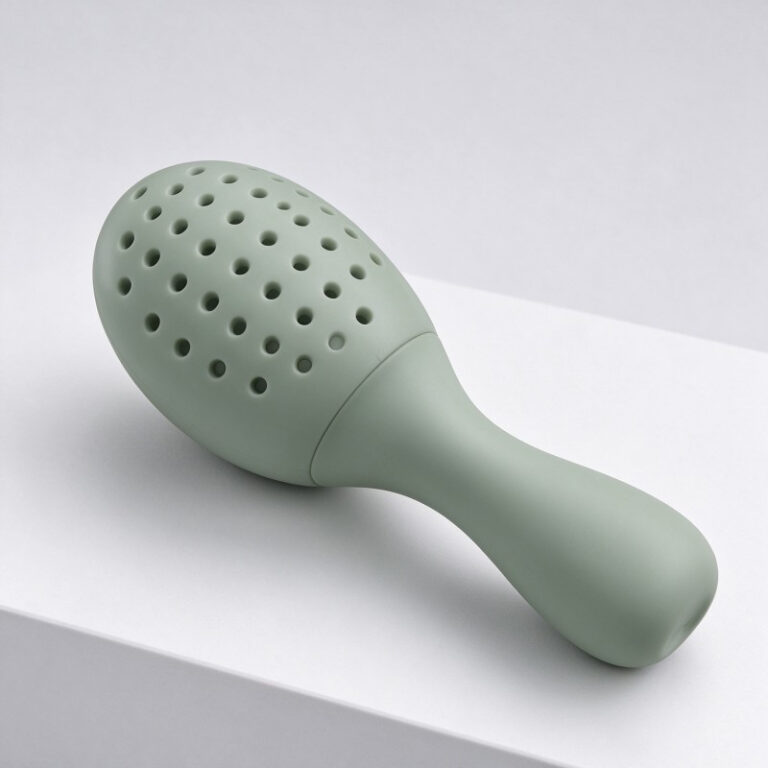
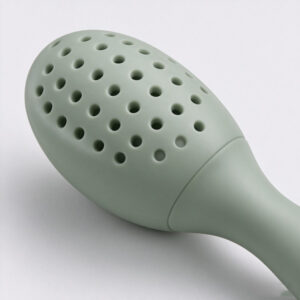
A silicone baby fruit feeder is more than a soft handle with a perforated feeding head. Its function depends on how the food reaches the openings, how the silicone structure responds to pressure, and how easily residue can be removed afterward.
A design may look attractive in a product rendering but behave differently when filled with food. Openings that appear evenly spaced may not provide consistent flow if their dimensions vary. A flexible feeding head may also change shape under pressure, affecting the available flow path.
For product developers, the key question is not simply whether food can pass through an opening. It is whether the intended food can move through the complete structure in a controlled and repeatable way.
LYA’s silicone baby teether category provides a relevant product-category reference. This article focuses on a narrower engineering requirement: opening geometry, food-flow consistency, cleaning access, and OEM sample validation.
Why Do Fruit Feeder Openings Clog or Release Food Unevenly?
Several factors can contribute to inconsistent flow. The actual cause should be identified through sample evaluation rather than assumed from the appearance of the feeding head.
1. The openings do not match the intended food consistency
A fruit feeder intended for one type of prepared food may behave differently with another. Food viscosity, particle size, moisture content, and preparation method can all influence how material moves through an opening.
If the opening is too restrictive for the defined application, food may accumulate near the feeding surface. If the opening is too large, the product may release more material than intended or fail to retain the intended food pieces.
The manufacturer should therefore work from the brand’s defined use requirements. A generic statement such as “suitable for fruit” does not provide enough information for detailed flow design.
2. Opening size and spacing are inconsistent
Even when the nominal design is correct, variation between openings can produce uneven flow. A partially formed opening, excess flash, or local deformation can change the effective passage area.
The design should consider both the opening dimensions and the amount of silicone material between adjacent openings. Very narrow material bridges may be difficult to mold consistently or may deform differently from the surrounding surface.
3. The feeding head changes shape under pressure
Silicone flexibility is useful for a soft product, but the feeding head should not deform unpredictably during normal handling.
If the head collapses or bends around the openings, the flow path may become restricted. If the structure is too rigid for the intended operation, the user may need more force than expected to operate it.
This is a geometry-and-material problem, not necessarily a problem that can be solved by changing the silicone hardness alone.
4. Food residue builds up around the openings
Residue may collect along the opening edges or inside nearby recesses. If the design includes deep grooves, narrow transitions, or surfaces that are difficult to reach, cleaning may become more difficult.
A product can pass a basic flow check and still be inconvenient to clean. These functions should be assessed separately.
5. The design has not been tested using a consistent method
A sample may appear to work well with one food consistency but perform differently with another. If the brand and manufacturer use different test materials, filling amounts, or operating methods, their conclusions may not be comparable.
Before tooling approval, the buyer and manufacturer should agree on the intended test conditions and what constitutes acceptable performance.
How Should Opening Geometry Be Developed?
Opening geometry should be developed around the product’s intended function, not selected only for appearance.
Define the target food before selecting the opening pattern
The product brief should identify the intended food types and their relevant physical characteristics. For example, a smooth puree and a preparation containing small soft particles may require different flow behavior.
The development team should document the agreed test materials and preparation method. This makes it easier to compare samples and understand whether a change in opening geometry improves performance.
Balance opening size with material support
Making every opening larger is not a universal solution. Opening dimensions affect food passage, material strength, visual appearance, cleaning, and mold feasibility.
The silicone bridges between openings need enough structural support to retain their intended shape. The finished feeding head should also be inspected for irregular edges, incomplete formation, and local deformation.
The dimensional tolerance guide can help the project team identify which dimensions need a defined measurement method and acceptance limit.
Review opening distribution, not just individual holes
A feeding head with evenly distributed openings may behave differently from one with a concentrated opening area and a more solid perimeter. The layout should reflect the intended flow path and the way the feeding head is expected to be used.
Before approving a pattern, review:
-
Opening size and shape
-
Spacing between adjacent openings
-
Silicone material between openings
-
Feeding-head curvature
-
The transition between the head and handle
-
Mold filling and demolding feasibility
-
Ease of inspecting the finished openings
These decisions should be validated on actual molded samples rather than accepted solely from a 3D drawing.
How Does Silicone Flexibility Affect Food Flow?
The feeding head, opening pattern, and surrounding wall structure need to work together. A material change may affect the product’s feel, but it does not automatically correct a poorly designed flow path.
Avoid uncontrolled deformation
If the feeding head is too flexible for the intended use, pressure may distort the openings or change the shape of the food-contact area. If the structure is too stiff, the product may be harder to operate in the intended way.
The design team should evaluate silicone hardness together with wall thickness, head curvature, opening geometry, and the transition to the handle.
Control thickness transitions
Abrupt changes between thick and thin areas can cause uneven deformation. Rounded transitions and a controlled thickness distribution can make the structure more predictable, subject to the final product design and molding requirements.
The wall thickness design guide provides additional context for reviewing flexibility, structural support, and thickness transitions.
There is no single wall thickness or hardness that is appropriate for every fruit feeder. The final specification should be based on the actual design, intended use, and sample results.
Cleaning Is a Design Requirement, Not a Label
A feeding product should be evaluated for cleaning access as well as food flow.
Opening edges, narrow recesses, deep textures, and transitions between the feeding head and handle can affect how easily residue is removed. The design should allow the intended cleaning method to reach relevant surfaces without relying on inaccessible corners or narrow passages.
Before tooling, review:
-
Whether both sides of the openings can be inspected
-
Whether food residue can be removed from the feeding head
-
Whether narrow grooves or recesses are necessary for the function
-
Whether the product can be rinsed and dried as intended
-
Whether the care instructions match the validated product design
The drainage and easy-clean design guide explains why cleaning access and product geometry need to be considered during design rather than added as an afterthought.
Do not automatically claim that a product is dishwasher-safe, boil-safe, or suitable for a specific sterilization method. Those claims should be confirmed for the actual material, complete product structure, and intended market.
What Should OEM Buyers Confirm Before Tooling?
A product brief should describe the intended function of the fruit feeder as clearly as its appearance.
Before tooling, buyers should confirm:
-
Target application: Define the intended food types, consistency, and use conditions.
-
Target market: Identify the destination market and applicable product requirements.
-
Feeding-head geometry: Provide a drawing, reference sample, or clear structural description.
-
Opening pattern: Specify the proposed size, shape, distribution, and visual standard.
-
Material and flexibility: Define the material requirements and desired behavior, subject to sample validation.
-
Handle structure: Confirm the grip shape and the transition between the handle and feeding head.
-
Cleaning requirements: Describe the intended cleaning method and any relevant care instructions.
-
Branding and packaging: Confirm color, logo method, packaging, labels, and instructions.
-
Quality requirements: Identify critical dimensions, appearance standards, and functional acceptance criteria.
-
Commercial requirements: Provide estimated order quantity and expected product launch timing.
The custom silicone mold development checklist can help organize these details before the design is released for tooling.
For baby products, material suitability and final-product requirements must be evaluated for the actual design and intended market. A product concept or material description alone does not establish that the finished product meets every applicable requirement.
How Should Samples Be Validated?
Sample approval should test the product’s real function, not just its appearance.
1. Agree on the test material and method
Use the food types or representative test materials agreed by the brand and manufacturer. Keep the preparation method, filling amount, and operating procedure consistent between samples.
If the product is intended for different food consistencies, assess each defined use case separately rather than assuming one test represents all possible applications.
2. Observe flow consistency
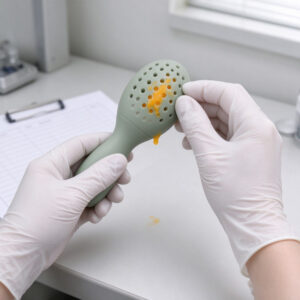
Check whether food moves through the intended openings in a repeatable way. Record any visible blockage, uneven release, unexpected deformation, or accumulation around the opening area.
The test should have written pass/fail criteria. Do not invent a universal flow rate or operating-force value for all fruit feeders.
3. Inspect cleaning access
After the flow test, use the agreed cleaning procedure and inspect the feeding head. Check whether residue remains around the openings, inside recesses, or along the transition areas.
The result should be evaluated against the intended care instructions and acceptance criteria.
4. Inspect the molded structure
Check for incomplete openings, excess flash, uneven edges, deformation, surface defects, and variation in the feeding-head geometry. If the mold uses multiple cavities, compare samples from the relevant cavities.
5. Repeat the test across samples
One sample is not enough to establish production consistency. Compare multiple molded samples using the same procedure and record the results.
The approved sample, drawing, test method, and acceptance criteria should refer to the same design revision before mass production is authorized.
Frequently Asked Questions
What causes a silicone baby fruit feeder to clog?
Potential causes include openings that do not match the intended food consistency, inconsistent opening geometry, deformation of the feeding head, or residue accumulating around the openings. The actual cause should be confirmed through controlled sample testing.
Can larger openings solve uneven food flow?
Not always. Larger openings may change the amount of food released, reduce the material between openings, and affect the intended function. Opening size should be evaluated together with spacing, feeding-head geometry, and the target use conditions.
Should all openings have the same size?
A uniform pattern may be suitable for some designs, but the correct layout depends on the intended flow path and structure. Any variation between opening zones should have a defined functional reason and be validated on samples.
Can softer silicone improve dispensing?
Not necessarily. Softer silicone may increase flexibility, but it can also allow the feeding head to deform. Material hardness, wall thickness, opening geometry, and the intended operating action should be assessed together.
What should buyers validate before mass production?
Buyers should confirm flow consistency, opening formation, structural integrity, cleaning access, dimensions, appearance, packaging, and the applicable product requirements. The final acceptance criteria should be agreed before production approval.
Develop the Flow Path Before Approving the Mold
A silicone baby fruit feeder depends on a coordinated design: opening geometry, material flexibility, feeding-head structure, cleaning access, and a repeatable manufacturing process.
Simply enlarging the openings or changing the silicone hardness may not resolve the underlying problem. The better approach is to define the intended application, review the structure before tooling, and validate molded samples using an agreed test method.
LYA supports OEM/ODM product development through its OEM silicone manufacturing service. For a new fruit-feeder project, contact LYA Silicone with your reference design, target food types, opening-pattern requirements, material preferences, packaging concept, target market, and estimated order quantity.