 Polish
  English
  French
  German
  Spanish
  Chinese
  Japanese
  Korean
  Russian
 Zawartość
Answer Excerpt
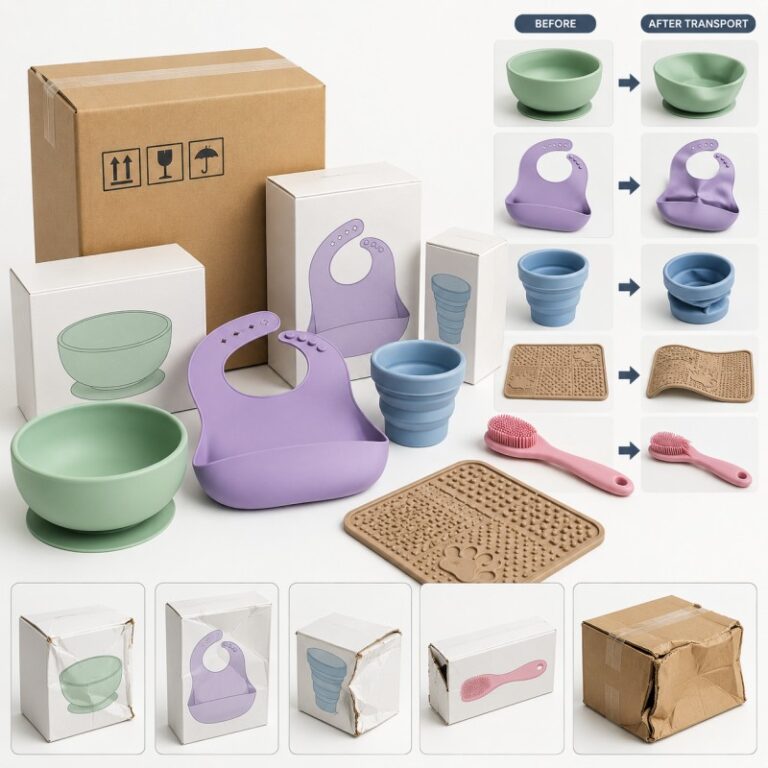
Silicone products may deform after packaging and shipping when they are folded, compressed, stacked or restrained in an unsuitable position for too long. The risk depends on product geometry, wall thickness, hardness, curing stability, packaging pressure, storage temperature and recovery time. Suction bases, bib pockets, brush bristles and collapsible structures should therefore be tested in their final packaging before mass production.
A produkt silikonowy may pass dimensional and functional inspection immediately after molding but still arrive at the customer with a distorted shape.
Common complaints include:
- A suction bowl no longer lies flat
- A silicone bib pocket remains closed
- A collapsible cup opens unevenly
- Brush bristles become bent
- A pet lick mat develops curled edges
- A silicone lid no longer fits correctly
- A folded product shows permanent crease marks
These problems are not always caused by the silicone material or mold alone.
The packaging method, carton pressure, storage position and transportation conditions can also change the product’s final shape and function.
For B2B buyers, packaging should therefore be treated as part of product engineering—not only as a graphic-design or shipping-cost decision.
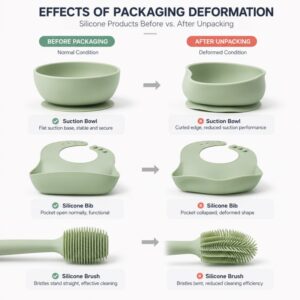
What Does Packaging Deformation Mean?
Packaging deformation occurs when a silicone product changes shape while it is:
- Folded into an individual bag
- Pressed into a small retail box
- Stacked under other products
- Held by a blister or paper insert
- Compressed inside a master carton
- Stored for an extended period
- Exposed to elevated temperature
- Transported under vibration and pressure
Some deformation is temporary.
After the product is removed from the package, it may gradually return to its intended shape.
Other deformation affects the product for a longer period or changes its performance enough to create a quality complaint.
The important question is not only:
Does the product look deformed after unpacking?
The buyer and manufacturer should also ask:
- How long does recovery take?
- Does the product return completely?
- Is the function affected?
- Does the customer know how to restore the product?
- Will the product still look acceptable on a retail shelf?
- Does the packaging create repeatable batch-to-batch deformation?
Which Silicone Products Are Most Sensitive to Packaging?
Silicone Suction Bowls and Plates
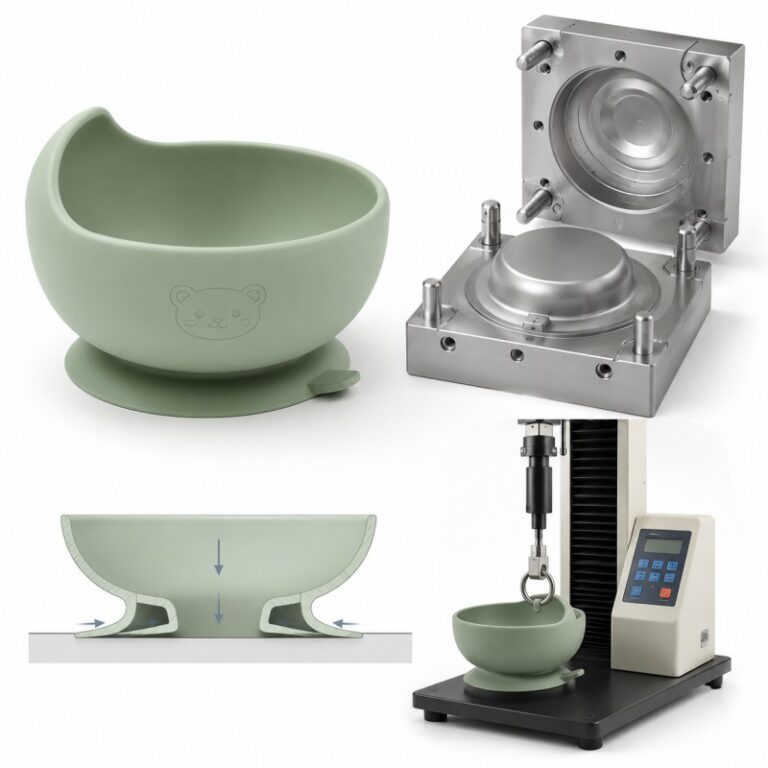
Suction products depend on the flatness and geometry of the suction base.
If the base is folded, tilted or pressed against another object during packaging, the sealing edge may no longer contact the table evenly.
Possible results include:
- Reduced suction force
- Air leakage under the base
- Rocking or uneven contact
- One side lifting before the other
- Different test results between samples
A product may look acceptable from above while the suction edge underneath is already distorted.
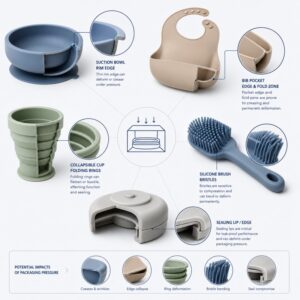
Silicone Baby Bibs
A silicone bib pocket must remain open enough to collect food.
If the bib is rolled too tightly or folded across the pocket for a long period, the pocket may:
- Collapse inward
- Stay closed after unpacking
- Twist to one side
- Lose its intended opening
- Sit too close to the body
- Recover slowly
This affects both the product’s appearance and its food-catching function.
The fold line should not pass through the most sensitive pocket-support area unless the structure has been validated for that packaging method.
Collapsible Silicone Cups and Bowls
Collapsible products are designed to fold, but that does not mean they can be compressed in any position.
The folding rings must move in a controlled sequence.
Incorrect packaging may cause:
- One ring to invert
- The wall to fold sideways
- Permanent creases
- Uneven reopening
- A tilted base
- A product that re-collapses by itself
A collapsible structure should be packaged in its approved folded or expanded condition—not whichever position occupies the least space.
Silicone Brushes and Bristled Products
Silicone bath brushes, pet grooming brushes and facial-cleaning tools often contain thin flexible bristles.
If the bristles are pressed against a flat bag or box wall, they may bend and remain in one direction.
Risks include:
- Uneven bristle height
- Reduced cleaning contact
- Poor visual appearance
- Bristle groups sticking together
- Permanent local bending
- Customer perception of low quality
The packaging should provide enough clearance around the bristles.
Silicone Mats and Flat Products
Lick mats, feeding mats, placemats and drying mats may be rolled or folded to save space.
However, long-term compression can produce:
- Curled corners
- Raised edges
- Center buckling
- Surface impressions
- Distorted suction cups
- Difficulty lying flat
Thin products are not automatically safer from deformation. Their low bending stiffness may actually make them more sensitive to packaging position.
Why Does Silicone Recover Slowly After Compression?
Silicone is flexible, but its recovery is affected by more than material hardness.
Important factors include:
- Product wall thickness
- Cross-sectional shape
- Length of compression
- Compression amount
- Storage temperature
- Material formulation
- Curing stability
- Post-curing condition
- Internal stress
- Surface contact
- Product age
- Packaging restraint
A soft silicone product may bend easily, but it may also stay in the packaged shape longer because the structure provides limited restoring force.
A harder product may resist packaging pressure but can transfer stress to a thin transition area.
For this reason, selecting a higher or lower Shore A hardness alone does not solve every packaging problem.
Material hardness must be evaluated together with the complete product geometry.
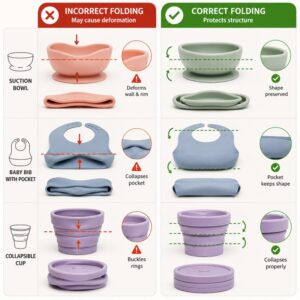
1. Excessive Folding Is a Common Cause
Folding reduces package size, but the fold position matters.
A poor fold line may pass through:
- A suction edge
- A pocket support
- A sealing surface
- A hinge transition
- A thin rib
- A logo area
- A functional opening
- A brush head
- A cup folding ring
Sharp folding creates concentrated strain.
When the product remains folded for days or weeks, the affected area may need more time to recover.
Instead of selecting the smallest possible package first, the packaging team should identify which areas can safely bend.
2. Product-to-Box Fit May Be Too Tight
A retail box that is only slightly smaller than the relaxed product can continuously compress the silicone.
This can occur when:
- The box dimensions are based on a hand-folded sample
- Carton tolerance is not considered
- The product varies slightly in thickness
- Accessories are added later
- Instructions press against the product
- The internal insert is too rigid
- The product is packed in the wrong orientation
The product may look acceptable when one sample is placed in the box manually.
However, mass-production packing may create greater pressure because workers, fixtures and automated processes position products differently.
Packaging clearance should therefore be confirmed using multiple production samples.
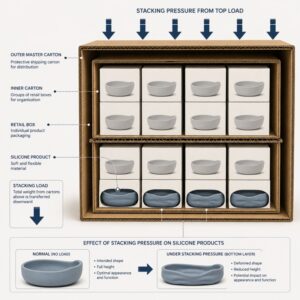
3. Stacking Pressure Can Change the Product Shape
Individual packaging is only one part of the system.
Products are also placed into inner cartons and master cartons.
A package at the bottom may experience pressure from:
- Products above it
- Carton stacking
- Pallet loading
- Warehouse storage
- Container loading
- Transport vibration
Flexible retail packaging may transfer this pressure directly to the silicone product.
The carton design should protect functional surfaces rather than relying only on the silicone product’s flexibility.
4. High Temperature Can Increase Deformation Risk
Shipping containers, warehouses and delivery vehicles may reach higher temperatures than normal indoor use.
Higher temperature can make a flexible silicone structure easier to distort while it is under pressure.
The product may then cool while still restrained in the packaged shape.
This does not mean the silicone material has melted.
It means the combination of temperature, pressure, time and geometry may increase temporary or longer-lasting deformation.
Packaging validation should consider realistic distribution temperatures for the target market.
5. The Product May Be Packed Too Soon After Production
A product should not automatically move from molding directly into tightly compressed packaging.
Depending on the product and process, the manufacturer may need time for:
- Cooling
- Dimensional stabilization
- Post-curing
- Czyszczenie
- Inspection
- Stress relaxation
- Final functional testing
If a warm or insufficiently stabilized product is immediately folded and compressed, the packaging can influence its final resting shape.
The approved production flow should specify when packaging may begin.
6. Packaging Materials Can Leave Surface Marks
Silicone surfaces may pick up impressions from:
- Corrugated paper
- Rough paper inserts
- Plastic seams
- Labels
- Zip-lock tracks
- Hard accessories
- Product-to-product contact
- Tight elastic bands
Glossy and matte surfaces can react differently to contact pressure.
A mark that disappears quickly may be acceptable for an internal transport package but unacceptable for a premium retail product.
The visual standard should define:
- Which contact marks are allowed
- How long recovery may take
- Which surfaces are cosmetic surfaces
- How products must be separated
- Whether protective film is needed
Why Can the Sample Pass but Mass Production Fail?
A sample may be packed carefully by an engineer or salesperson.
Mass-production packaging may involve:
- Different operators
- Faster packing speed
- Greater folding force
- Different product orientation
- Tighter cartons
- Larger stacking loads
- Longer storage time
- More variation between products
- Different transportation conditions
Therefore, approving one hand-packed sample is not enough.
The complete packaging method must be standardized.
The approval should include:
- Product orientation
- Folding sequence
- Accessories placement
- Bag size
- Box size
- Insert position
- Quantity per inner carton
- Quantity per master carton
- Carton stacking method
- Maximum storage time before shipment
How Should Packaging Be Designed for Silicone Products?
Protect Functional Geometry First
The most important functional surfaces should not be the main load-bearing areas in the package.
Examples include:
- Suction lips
- Sealing rims
- Thin valves
- Bib-pocket supports
- Bristle tips
- Folding rings
- Product openings
- Mating surfaces
Packaging should support stronger, less sensitive areas.
Use Controlled Folding
When folding is necessary, define:
- The correct fold direction
- The approved fold radius
- The number of folds
- The final product orientation
- Areas that must not be folded
- Maximum storage duration in the folded condition
Workers should not decide the fold method individually.
A visual packaging instruction is useful for preventing inconsistent folding.
Avoid Unnecessary Compression
A smaller box may reduce shipping volume, but the saving must be compared with the risk of:
- Product returns
- Customer complaints
- Lost suction
- Poor shelf appearance
- Additional recovery instructions
- Repacking costs
The smallest package is not always the lowest-cost solution when quality risk is included.
Separate Sensitive Surfaces
Paper sheets, molded trays, spacers or internal supports may help prevent products from pressing directly against one another.
However, the selected packaging material should also be checked for:
- Dust
- Paper fibers
- Odor
- Surface abrasion
- Ink transfer
- Adhesive contact
- Moisture
- Sustainability requirements
Packaging Validation Tests Before Mass Production
Packaging should be tested with the final production-intent product, not only with an early prototype.
1. Packed-Storage Test
Pack the product exactly as planned and store it for an agreed period.
After unpacking, evaluate:
- Immediate appearance
- Recovery after one hour
- Recovery after 24 hours
- Recovery after a longer agreed time
- Functional performance
- Surface marks
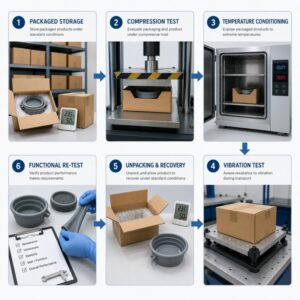
2. Compression Test
Apply a defined load to the retail or master package.
The purpose is to simulate stacking and distribution pressure.
After testing, inspect the silicone product for:
- Permanent distortion
- Curled edges
- Suction-base deformation
- Bristle bending
- Surface impressions
- Functional loss
3. Elevated-Temperature Storage Test
Store the packed product at an agreed elevated temperature.
The temperature and duration should be selected according to the product, packaging material and expected shipping environment.
Evaluate both shape and function after the product returns to normal room conditions.
4. Transportation Simulation
Transportation validation may include:
- Vibration
- Drop testing
- Carton stacking
- Repeated handling
- Pallet compression
The goal is not only to check whether the carton breaks.
The silicone product inside must also remain acceptable.
5. Unpacking and Recovery Test
Define a consistent unpacking procedure.
Record:
- Shape immediately after unpacking
- Time required for recovery
- Manual restoration steps, if any
- Whether warm water is required
- Whether function returns fully
- Whether the recovery instruction is suitable for the customer
A product should not depend on an unclear or unrealistic restoration method.
Product-Specific Packaging Checklist
| Typ produktu | Main Packaging Risk | What to Validate |
|---|---|---|
| Suction bowl or plate | Distorted suction base | Flatness, sealing edge and suction test |
| Śliniak silikonowy | Collapsed pocket | Pocket opening and recovery after folding |
| Collapsible cup | Uneven folding rings | Reopening, base stability and repeated folding |
| Pet lick mat | Curled corners | Flatness and suction-cup condition |
| Silicone brush | Bent bristles | Bristle height, direction and cleaning contact |
| Silicone lid | Distorted sealing rim | Fit, leakage and assembly force |
| Teether | Surface marks or shape distortion | Appearance, dimensions and oral-contact surfaces |
| Feeding mat | Rolling memory | Flatness after unpacking and storage |
| Product set | Components pressing together | Contact marks, deformation and set arrangement |
What Should Be Approved Before Production?
Before releasing mass production, the buyer and manufacturer should approve:
- Final molded sample
- Material and hardness
- Product dimensions
- Functional standard
- Kolor
- Surface finish
- Logo
- Individual packaging
- Folding method
- Packaging insert
- Retail box
- Carton quantity
- Storage orientation
- Recovery criteria
- Transportation test plan
- Approved packaged reference sample
A sample should be approved in its final packaged condition whenever packaging can affect product function.
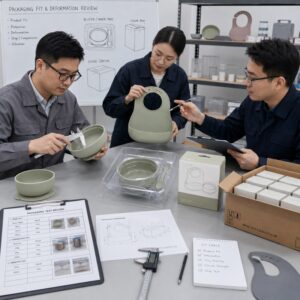
How LYA Silicone Supports Packaging Validation
LYA Silicone supports custom silicone product development for baby, pet, household, outdoor and educational product brands.
Project review may include:
- Product-structure evaluation
- Material and hardness discussion
- Mold-development review
- Sample production
- Functional testing
- Packaging-fit review
- Folding and recovery evaluation
- Product-set arrangement
- Pilot production
- Dimensional and appearance inspection
- Mass-production quality control
For products with suction, folding, bristles, flexible pockets or sealing structures, buyers should provide the intended packaging concept before production approval.
This allows the product and packaging to be evaluated as one complete system.
Frequently Asked Questions
Will Silicone Always Return to Its Original Shape?
Not necessarily within the same amount of time.
Recovery depends on product structure, wall thickness, material, compression, temperature and storage duration. The actual packaged product should be tested.
Can I Roll a Silicone Product to Reduce Shipping Volume?
Possibly, but the roll diameter, direction, storage time and product structure must be validated.
Rolling may be suitable for some mats but unsuitable for suction edges or structured pockets.
Does Harder Silicone Prevent Packaging Deformation?
Not in every case.
Higher hardness may increase structural resistance, but it can also change folding, suction, sealing, user comfort and mold release. Hardness should not be changed only to solve packaging without testing the complete product.
Can Hot Water Restore a Deformed Silicone Product?
Some products may recover more quickly after controlled warming, but this should not be assumed as the standard solution.
The product’s use conditions and customer instructions must be considered.
Should Packaging Be Approved Before the Mold Is Finished?
The final package normally cannot be validated before production-intent samples exist.
However, the package size, folding direction and product orientation should be considered during product and mold development.
Why Does One Color Recover Differently from Another?
The cause may involve material batch, pigment loading, product thickness, temperature history, curing condition or testing variation.
The issue should be investigated using controlled samples rather than assuming color alone is responsible.
Can Products Be Packed Immediately After Molding?
The approved production process should define cooling, stabilization, inspection and any post-curing requirements before packaging.
Should a Packaged Reference Sample Be Retained?
Tak.
A retained packaged sample helps the manufacturer and buyer compare future batches with the approved product, folding method and package arrangement.
Prevent Packaging from Becoming a Product Defect
Packaging is the last production step before shipment, but it can change the work completed during design, tooling, molding and inspection.
A silicone product should not be approved only when it is lying freely on an inspection table.
It should also be approved after:
- Final folding
- Final retail packaging
- Carton stacking
- Przechowywanie
- Transportation simulation
- Unpacking
- Recovery
- Functional retesting
To review packaging risks for a custom silicone product, send Silikon LYA the product drawing, sample, intended packaging, carton arrangement, target market, shipping method and estimated order quantity.