 English
  French
  German
  Spanish
  Polish
  Chinese
  Japanese
  Korean
  Russian
 Contents
For global baby product brands, distributors, and importers, safety is the single most critical factor when selecting materials and manufacturing partners. One of the most frequently asked questions from B2B buyers is:
“Is it truly safe for babies to chew silicone baby products for long periods of time?”
The short answer is yes—when medical- or food-grade silicone is properly designed, formulated, and manufactured by a qualified factory.
In this article, we provide a science-based, regulation-backed explanation of why high-quality silicone is widely trusted for infant teething and feeding products, what standards B2B buyers should look for, and how experienced manufacturers like LYA Silicone support long-term safety through material control and precision molding.
Why Babies Chew – And Why Material Choice Matters
Babies naturally explore the world through their mouths. Teething discomfort, sensory development, and muscle coordination all lead infants to chew, suck, and bite products for extended periods. This means baby products must meet much higher safety and durability standards than ordinary consumer goods.
Key risks that manufacturers and buyers must eliminate include:
- Chemical migration or leaching
- Toxic additives or plasticizers
- Micro-cracking that traps bacteria
- Heat instability during sterilization
- Allergic reactions or irritation
Scientific Reasons Silicone Is Safe for Long-Term Oral Contact
1. Chemically Inert and Non-Toxic
High-quality silicone is a stable polymer composed of silicon, oxygen, carbon, and hydrogen. Unlike plastics such as PVC or some TPEs, silicone does not rely on plasticizers like BPA, BPS, or phthalates to remain flexible.
As a result:
- No BPA, BPS, PVC, latex, or phthalates
- No taste or odor transfer
- No harmful chemical release during chewing
2. Excellent Thermal Stability for Repeated Sterilization
Baby products must withstand frequent cleaning and sterilization. Silicone maintains its structure and safety across a wide temperature range:
- Heat resistance up to 200–230°C (392–446°F)
- Safe for boiling water, steam sterilization, and dishwashers
- Does not degrade or release substances under heat
3. High Tear Resistance and Elastic Recovery
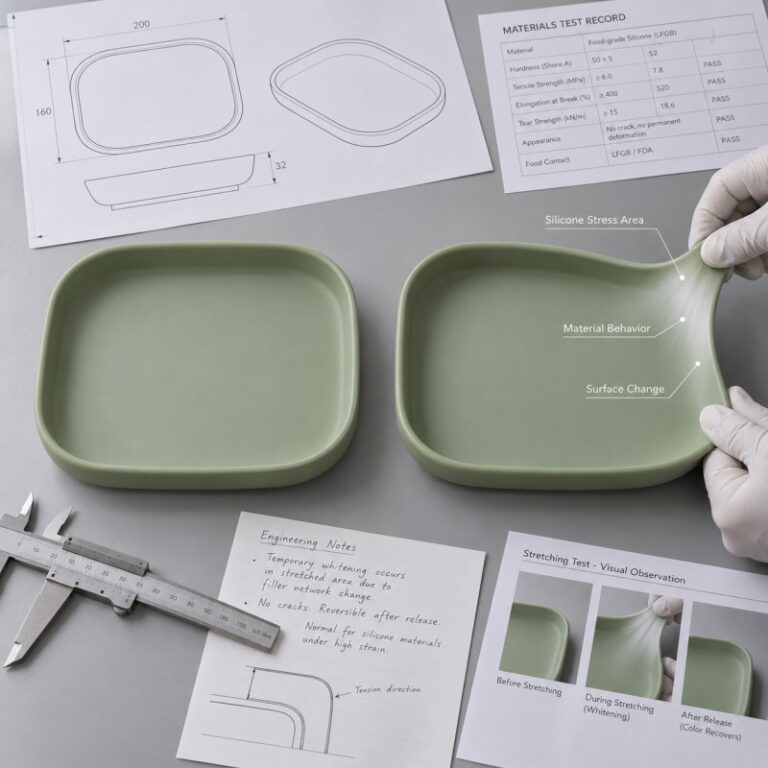
When babies bite silicone products, the material must resist tearing and permanent deformation.
Liquid silicone rubber (LSR) offers:
- High elongation and tear strength
- Excellent rebound after compression
- No cracking or fragmentation during prolonged chewing
4. Naturally Hypoallergenic and Skin-Friendly
Silicone is biocompatible and hypoallergenic, making it ideal for sensitive infant skin and gums. It does not support mold growth and resists bacterial adhesion when properly molded and finished.
This makes silicone especially suitable for:
- Baby teethers
- Pacifiers
- Feeding spoons
- Bottle nipples
- Silicone baby feeding sets
Regulatory Standards That Define Safe Silicone Baby Products
For foreign B2B buyers, safety claims must be supported by recognized international certifications. Reputable silicone baby product manufacturers should comply with:
United States
- FDA 21 CFR 177.2600 – Food-contact silicone rubber
- CPSIA requirements for children’s products
European Union
- LFGB (Germany food-contact standard – stricter than FDA)
- EN 71-3 (migration of certain elements)
- REACH & RoHS compliance
Global
- BPA Free / Phthalate Free testing
- Heavy metal migration testing
Why Manufacturing Process Is as Important as Material
Even the safest silicone can become unsafe if the manufacturing process is poorly controlled.
Key manufacturing factors include:
- Accurate LSR mixing ratios
- Controlled curing temperatures
- Precision steel molds with smooth cavities
- Burr-free, seamless parting lines
- Cleanroom or controlled production environments
As an experienced silicone manufacturer, LYA Silicone integrates:
- In-house mold design & tooling
- Advanced LSR injection molding
- Silicone overmolding capabilities
- Strict in-process quality inspection


Recommended Silicone Baby Products for Oral Use
For B2B buyers looking to expand or optimize their baby product lines, silicone is ideal for:
- Silicone baby teethers
- Silicone feeding spoons & forks
- Silicone baby bottle nipples
- Silicone bibs and feeding sets
- Custom-designed infant oral-care products


Frequently Asked Questions (FAQ)
Q1: Can babies chew silicone products for hours every day?
Yes. Food-grade and medical-grade silicone is designed for prolonged oral contact. When manufactured correctly, it remains stable, non-toxic, and durable even with frequent chewing.
Q2: Is silicone safer than plastic for baby products?
In most cases, yes. Silicone does not require plasticizers, does not release BPA, and withstands heat better than most plastics, making it safer for teething and feeding applications.
Q3: Will silicone break down over time in a baby’s mouth?
High-quality LSR silicone does not degrade, flake, or crack under normal use. This is why proper material selection and molding quality are essential.
Q4: What certifications should B2B buyers require from a silicone factory?
Look for FDA, LFGB, BPA-free, REACH, and EN 71-3 compliance, along with material traceability and testing reports.
Q5: Can LYA Silicone support custom baby product development?
Yes. LYA Silicone provides OEM & ODM services, including custom molds, material formulation, prototyping, and large-scale production for global baby brands.
Conclusion
When produced by a qualified manufacturer, silicone baby products are among the safest choices for long-term chewing and oral contact. Backed by scientific stability, global regulations, and proven real-world performance, silicone has become the preferred material for modern infant products.
For brands and distributors seeking a reliable silicone baby product manufacturing partner, LYA Silicone offers the expertise, compliance, and production capability needed to succeed in international markets.
-
 Email: sale11@lyasilicone.com
 -
 Phone: +86-13420974883
 -
 Website: www.lyasilicone.com
Looking for a reliable silicone manufacturer? Explore baby-safe silicone teethers from LYA Silicone.