 English
  French
  German
  Spanish
  Polish
  Chinese
  Japanese
  Korean
  Russian
 Contents
Answer Excerpt
Choosing a silicone straw cup manufacturer should involve more than comparing unit price and product appearance. Baby brands should evaluate silicone material control, cup-body hardness, lid-to-rim fit, straw-hole geometry, airflow design, mold development capability, sample validation, multi-cavity consistency, packaging and quality inspection. A reliable supplier should be able to explain how the complete cup system will be designed, molded, tested and reproduced during mass production.
A silicone straw cup looks like a simple baby feeding product.
In reality, it is a multi-part functional system.
A typical product may include:
- Silicone cup body
- Removable silicone lid
- Silicone straw
- Straw opening
- Air vent
- Handles
- Sealing rim
- Optional valve or spill-control feature
If any of these parts are poorly designed, the finished product may:
- Leak
- Drip
- Become difficult to drink from
- Collapse when squeezed
- Lose lid retention
- Hold odor or residue
- Feel too soft or too stiff
- Change fit between production batches
That is why baby brands should evaluate both the product and the manufacturer before opening a custom mold.
1. Does the Manufacturer Understand the Complete Straw Cup System?
The first thing to check is whether the supplier evaluates the cup as a complete assembly.
A good manufacturer should not treat:
- Cup
- Lid
- Straw
- Vent
- Handles
as five unrelated silicone parts.
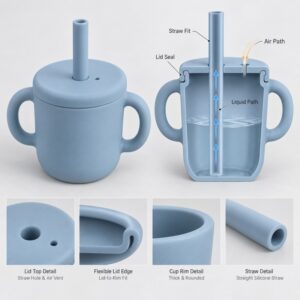
The lid must fit the cup rim.
The straw must fit the straw opening.
The air vent must support drinking flow.
The cup body must remain stable enough during use.
Your current silicone straw cup engineering guide already explains that liquid flow and air replacement need to work together, and that leakage can come from the lid, straw opening, vent, valve or assembly condition.
This is exactly why supplier selection should begin with system-level engineering capability.
2. Can the Manufacturer Explain the Material Selection?
A buyer should ask:
- What silicone material is recommended?
- What hardness range is appropriate?
- Is the cup body translucent or opaque?
- Does the lid need the same hardness as the cup?
- Should the straw use the same formulation?
- How will the material be controlled between batches?
The answer should depend on product function.
A softer cup body may:
- Feel comfortable
- Be easier to squeeze
- Feel more flexible in a child’s hand
But if it is too soft, it may:
- Collapse during drinking
- Deform under lid pressure
- Change the rim shape
- Affect sealing
A harder cup may provide more stability, but excessive hardness can reduce the soft-touch experience.
Your current silicone hardness guide already emphasizes that Shore A should be evaluated together with wall thickness, geometry, suction, folding and actual product function rather than treated as an isolated number.
For a straw cup, hardness selection should be evaluated on molded samples.
3. Can the Supplier Control the Lid-to-Rim Fit?
The cup rim and silicone lid form one of the most important sealing interfaces.
If the lid is too loose:
- It may lift
- Liquid may leak
- The lid may shift during use
If the lid is too tight:
- Assembly may require excessive force
- The cup body may deform
- Parents may find cleaning and reassembly inconvenient
The manufacturer should therefore review:
- Cup-rim diameter
- Rim thickness
- Lid inner diameter
- Lid groove
- Overlap
- Silicone hardness
- Shrinkage
- Finished dimensions
For flexible silicone products, nominal CAD dimensions alone are not enough.
The actual molded fit needs to be tested.
4. Does the Manufacturer Understand Straw-Hole Geometry?
The straw opening may appear very simple, but small dimensional differences can change performance.
If the opening is too large:
- Leakage may increase
- The straw may move too freely
- Liquid can escape around the straw
If the opening is too tight:
- Assembly becomes difficult
- The straw may pinch
- Flow may be restricted
- The lid may deform
The supplier should therefore control:
- Straw outer diameter
- Hole diameter
- Hole thickness
- Local lid thickness
- Surface finish
- Hole geometry
For a custom silicone straw cup, this is a functional tolerance rather than only a visual detail.
5. Can the Manufacturer Design the Airflow Correctly?
A user removes liquid through the straw.
Air must then enter the cup to replace the removed volume.
If the airflow is too restricted, the cup may show:
- High suction resistance
- Interrupted drinking
- Cup-wall collapse
- Pulsing liquid flow
If the airflow is too open, spill control can become worse.
A good supplier should therefore understand the relationship between:
straw flow + air vent + lid sealing + cup-body flexibility
The objective is not simply to make the cup “leakproof.”
A product that does not leak but is too difficult to drink from is not a successful design.
6. Can the Manufacturer Support Custom Silicone Mold Development?
A private-label baby brand often wants more than an existing product.
It may want:
- Custom cup height
- Custom handle shape
- Different lid geometry
- Custom straw length
- Custom logo
- Custom color
- Custom volume
- Different rim structure
- Private mold
In that case, the manufacturer needs real custom silicone mold development capability.
Your current mold-development guide emphasizes reviewing material, hardness, geometry, wall thickness, molding method and functional requirements before tooling.
Before opening a mold, the supplier should review:
- Product structure
- Mold parting line
- Gate position
- Venting
- Wall thickness
- Demolding
- Shrinkage
- Critical fit dimensions
A supplier that only says “we can make it” without reviewing these factors creates more risk later.
7. Can the Manufacturer Explain Which Process Will Be Used?
Different silicone parts may be produced through different molding routes depending on structure and quantity.
Possible processes include:
- Compression molding
- Liquid silicone injection molding
- Secondary molding
- Multi-part assembly
The process should match the actual product geometry.
A manufacturer should be able to explain:
- Why a process is selected
- How it affects tooling
- How it affects flash
- How it affects parting lines
- How it affects production volume
- How it affects consistency
The most advanced-sounding process is not automatically the best choice.
The correct process is the one that can repeatedly produce the required structure and quality.
8. Does the Manufacturer Test Leakage Under Real Conditions?
A cup that passes one upright test may still leak during real use.
Sample testing should consider conditions such as:
- Upright
- Tilted
- Inverted
- Shaken
- Squeezed
- Straw installed
- Straw removed
- Warm liquid
- Repeated lid assembly
Your existing straw-cup failure guide already notes that leakage conditions need to be identified specifically because a product may behave differently when tilted, shaken, dropped or squeezed.
For OEM projects, the buyer and supplier should agree on the actual test method before mass production.
9. Does the Manufacturer Test Drinking Flow?
Leakage is only half of the system.
The user also needs comfortable liquid flow.
The factory should check:
- Straw diameter
- Straw length
- Vent behavior
- Flow resistance
- Cup collapse during suction
- Repeated drinking performance
A cup may technically hold liquid without leaking but still deliver poor user experience if excessive suction force is required.
For baby products, functional testing should simulate realistic use rather than only inspect appearance.
10. Can the Supplier Control Cleaning-Sensitive Areas?
Baby feeding products need practical cleaning.
The product should avoid unnecessary:
- Deep blind grooves
- Tight internal corners
- Hard-to-reach gaps
- Trapped residue around valves
- Complex inaccessible channels
This does not mean every product must be completely smooth.
It means functional structures should remain cleanable.
The buyer should inspect:
- Lid underside
- Straw hole
- Vent
- Rim groove
- Handle connection
- Straw interior
using the actual cleaning method expected by the target user.
11. Can the Manufacturer Maintain Dimensional Consistency?
A straw cup depends on several interacting dimensions.
Important dimensions may include:
- Cup-rim diameter
- Lid inner diameter
- Straw-hole diameter
- Straw outer diameter
- Vent size
- Cup height
- Wall thickness
These dimensions should not be treated as unrelated drawing values.
They form functional pairs.
For example:
straw OD ↔ lid hole
and
cup rim ↔ lid groove
If both parts are individually inside tolerance but at opposite ends of their allowable range, assembly performance may still change.
The supplier should therefore define functional dimensions and validate them together.
12. Can the Manufacturer Maintain Quality Across Multiple Mold Cavities?
Mass production may use multi-cavity molds.
Different cavities should not produce noticeably different:
- Lid fit
- Straw-hole fit
- Wall thickness
- Surface appearance
- Weight
- Flash
- Functional performance
During pilot production, samples should remain traceable to their cavities.
This helps the supplier determine whether a repeated leak or fit problem comes from:
- One cavity
- All cavities
- Material
- Process
- Assembly
For larger production orders, this type of traceability becomes increasingly useful.
13. Does the Supplier Have a Clear Sample Approval Process?
Brands should not approve only one attractive sample.
The sample approval package should ideally confirm:
- Current drawing revision
- Final color
- Material
- Hardness
- Dimensions
- Lid fit
- Straw fit
- Drinking flow
- Leakage
- Logo
- Surface finish
- Packaging
The approved reference should represent the actual product that mass production is expected to reproduce.
If the product changes after the first sample, the revision should also change.
14. Can the Manufacturer Handle OEM Color and Branding Properly?
Baby brands often care strongly about:
- Pantone colors
- Product collections
- Logo position
- Embossed logos
- Debossed logos
- Packaging style
The manufacturer should consider whether the logo location affects:
- Mold parting
- Surface texture
- Cleaning
- Product appearance
Color should also be approved on the actual molded product because the same nominal color can appear different on:
- Thin silicone
- Thick silicone
- Matte surfaces
- Smooth surfaces
- Translucent products
Branding needs to be evaluated together with production feasibility.
15. Does the Manufacturer Control Production Batches?
A reliable supplier should be able to connect finished production to relevant records such as:
- Material batch
- Color batch
- Production date
- Mold
- Cavity
- QC record
- Packaging batch
This becomes important when a complaint appears.
Instead of investigating the entire history of the product, the team can narrow the issue to the relevant batch.
For repeat orders, traceability also helps ensure the new production follows the same approved product revision.
Example: Private-Label Silicone Training Straw Cup
Consider a baby brand developing a mist-blue custom silicone straw cup.
The set contains:
- One-piece silicone cup body
- Two rounded side handles
- Removable silicone lid
- Straight silicone straw
- Small controlled air vent
The buyer wants:
- Soft touch
- Easy drinking
- Reduced spilling
- Easy cleaning
- Custom logo
- Private color
- Retail packaging
The manufacturer should review the product as one complete system.
Cup Body
Check hardness, wall thickness and shape stability.
Rim and Lid
Check fit, sealing and assembly force.
Straw Opening
Check straw retention without excessive friction.
Air Vent
Check drinking flow and spill behavior.
Handles
Check grip, wall transitions and moldability.
Cleaning
Check all interfaces after repeated assembly and washing.
Packaging
Confirm the package does not deform the lid or cup rim.
This is the type of review that separates a true OEM development partner from a supplier that simply reproduces an existing shape.

What Should Buyers Ask During Supplier Evaluation?
A practical RFQ should ask more than:
What is your price?
Useful questions include:
- What silicone material do you recommend?
- What hardness range do you recommend?
- How will the lid and cup fit be validated?
- How will straw-hole dimensions be controlled?
- How is airflow tested?
- What leak tests are performed?
- Can you develop a private mold?
- How are mold cavities inspected?
- How are color batches controlled?
- How are functional samples approved?
- How is production traceability maintained?
- How will repeat orders be compared with the approved sample?
The answers reveal much more than a quotation alone.
Silicone Straw Cup Manufacturer Checklist
| Item | What Buyers Should Confirm |
|---|---|
| Material | Appropriate silicone grade and batch control |
| Hardness | Validated on the actual cup structure |
| Cup rim | Stable and compatible with lid |
| Lid | Seals without excessive assembly force |
| Straw hole | Controlled fit with straw |
| Air vent | Supports drinking without excessive leakage |
| Wall thickness | Stable but comfortable |
| Mold | DFM completed before tooling |
| Leakage test | Multiple realistic positions tested |
| Drinking test | Flow resistance checked |
| Cleaning | Functional areas remain accessible |
| Cavities | Production consistency verified |
| Color / logo | Approved on molded samples |
| Packaging | Does not deform cup or lid |
| QC | Appearance, dimensions and function checked |
| Traceability | Production batch can be identified |
How LYA Silicone Supports Custom Straw Cup Development
LYA Silicone currently lists Silicone Straw Cup within its silicone baby product range and provides OEM/ODM development across custom silicone products.
Project support may include:
- Drawing review
- Product structure evaluation
- Silicone material selection
- Hardness review
- Mold development
- Custom color
- Logo customization
- Sample production
- Lid-fit testing
- Straw-flow testing
- Leakage review
- Multi-cavity inspection
- Packaging evaluation
- Mass-production quality control
The objective is not simply to manufacture a silicone cup.
The objective is to build a repeatable product system that works consistently from the first approved sample through mass production.
Frequently Asked Questions
What should I check first when choosing a silicone straw cup manufacturer?
Start with engineering capability rather than price. The supplier should understand lid fit, straw fit, airflow, hardness, mold development and functional testing.
Is a softer silicone straw cup always better?
No. If the cup is too soft, it may collapse or distort the lid interface. Hardness should be evaluated together with wall thickness and geometry.
Can a silicone straw cup be completely leakproof?
Leakage performance depends on the complete lid, straw, vent, valve and use condition. A product should be tested under the intended leakage standard rather than described with an absolute claim.
Should the lid and cup use the same silicone hardness?
Not necessarily. Different components may need different behavior, but any hardness combination should be validated in the final assembly.
Can I customize the cup shape and handles?
Yes, when the structure is suitable for custom tooling. The manufacturer should first perform a DFM review.
Should I test the cup after repeated washing?
Yes. Repeated cleaning and assembly can reveal fit, valve, straw and deformation issues that may not appear on a new sample.
Is the cheapest silicone straw cup manufacturer the best choice?
Not necessarily. Tooling, functional quality, consistency, defect rate, communication and repeat-order stability can have greater impact on total project cost than unit price alone.
Choose the Manufacturer That Can Explain the Product
A silicone straw cup is not just a cup with a straw.
It is a coordinated system of:
- Material
- Cup body
- Lid
- Straw
- Vent
- Mold
- Dimensions
- Functional testing
- Packaging
The most useful supplier is the one that can explain why each structure is designed the way it is and how it will remain consistent during mass production.
Before opening a custom straw cup mold, baby brands should review the complete product system with the manufacturer.
To discuss your private-label straw cup project, send LYA Silicone your reference product or 3D drawing, target capacity, required color, logo, material requirements, estimated quantity and target market.