 English
 French
 German
 Spanish
 Polish
 Chinese
 Japanese
 Korean
 Russian
Contents
Answer Excerpt
Silicone bath toys can tip over or float sideways when their outer shape, enclosed air volume and weight distribution do not produce a stable floating position. Not every silicone toy is designed to float: a solid silicone shape may sink, while a hollow design needs sufficient sealed air volume to provide buoyancy.
For OEM brands, floating balance is a product-specific performance requirement, not an automatic property of silicone. It should be evaluated through controlled water tests on molded samples, alongside seam integrity, cleaning and applicable toy-safety requirements.
Floating and Floating Upright Are Two Different Requirements
A toy that stays on the surface has enough overall buoyancy to support its weight. That does not mean its face, back or intended play features will point upward.
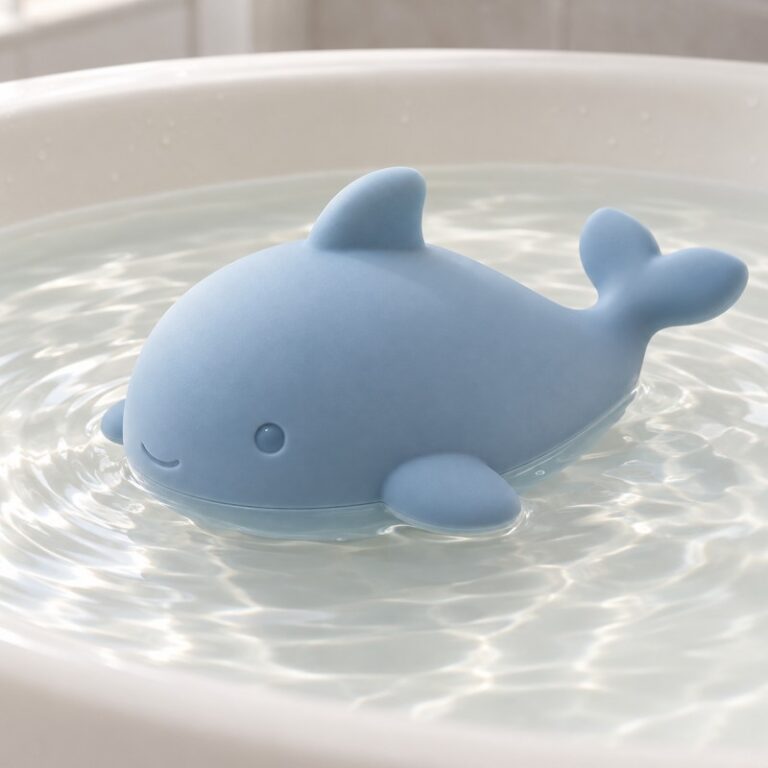
A whale-shaped bath toy, for example, might remain afloat while rolling onto one side. When developing custom silicone bath toys, ask two separate questions: will this particular construction float, and will it return to its intended orientation after a small disturbance?
Total displaced water determines whether buoyancy can support the toy. The relationship between the toy’s center of mass, submerged shape and shifting center of buoyancy influences its tendency to right itself or roll further.
Why Do Silicone Bath Toys Roll to One Side?
An uneven shape can shift the waterline
Animal features make products visually distinctive. A tall fin, projecting tail or asymmetrical decoration can also change the geometry above and below the waterline.
As the toy tilts, the shape of the submerged portion changes. The center of buoyancy moves, changing the torque acting on the toy. Depending on the complete geometry and weight distribution, the new torque may restore the intended position or encourage further rotation.
Silicone thickness affects mass distribution
A hollow toy can have a thin upper shell and a locally thicker lower shell, provided its tooling and use requirements permit that structure. Moving some of the silicone mass lower may help the desired orientation.
Excessive thickness adds material, changes cooling or curing behavior, and can make a flexible part less comfortable to squeeze. An abrupt thickness transition may also introduce manufacturing or durability concerns.
Do not add loose internal weights to an infant-oriented toy simply to make it sit upright. Introducing separate components would create additional manufacturing and safety risks.
Water entering an internal cavity changes everything
A chamber that relies on enclosed air may lose buoyancy if water enters through an opening or an inadequately sealed joint. A design that is intentionally openable should be assessed as an openable toy, not described as permanently watertight. Its wet-state floating behavior may differ from its dry-state behavior.
Does Silicone Itself Make a Bath Toy Float?
No. Silicone is not inherently a flotation device. The density of the selected compound, the weight of the finished article and the volume of water displaced by the entire assembled product determine its ability to float.
For many conventional solid silicone compounds, a dense solid shape may sink. A sealed hollow body can float because its enclosed air reduces the average density of the complete toy.
The existing baby bath toy OEM guide explains wider material, customization and cleaning considerations. Floating orientation needs its own functional acceptance plan.
A Manufacturable Concept: A Low-Profile Hollow Whale
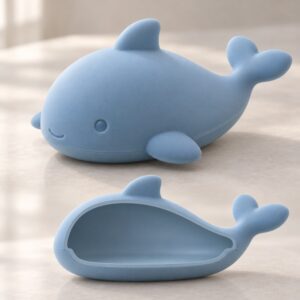
Consider a conceptual whale-shaped toy with a broad, rounded underside, short integral side fins and a modest dorsal fin. The outer surface is smooth, with no decorative attachments that could detach.
One possible construction uses two molded silicone shells permanently joined along a continuous perimeter interface, creating an enclosed air chamber. Whether that joining method is feasible, durable and suitable for the intended age group must be established through engineering review and testing. It is not a claim about an existing LYA production model.
The lower shell could be slightly thicker in defined areas than the upper shell, with gradual transitions. The goal is to explore floating balance without separate ballast pieces or unnecessarily complex features.
Before committing to a permanently enclosed cavity, the team should review the drainage and easy-clean design alternatives. A sealed design avoids intentional water entry but requires credible seam-integrity controls. An openable design offers inspection access but changes the functional and safety assessment.
How Should an OEM Floating-Balance Test Be Run?
A repeatable plan should document water conditions, sample condition, observation time and pass/fail criteria.
Step 1: Set the intended orientation
Agree on what “upright” means for the specific design. For a whale, this might mean the dorsal fin remains above the waterline and the face is visibly oriented upward. Define how much tilt, if any, the brand will accept.
Step 2: Establish a consistent starting condition
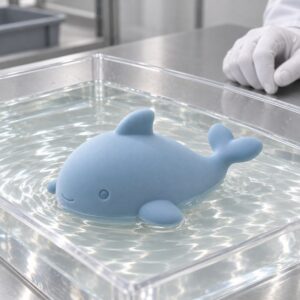
Use a level transparent water tank with the water depth, temperature and any permitted detergent exposure recorded. Inspect each sample for damage, unintended openings and visible manufacturing differences before testing.
Place the article gently on the water surface without holding it in the desired position. Record whether it floats, sinks, rotates or stabilizes on one side.
Step 3: Repeat after controlled disturbance
Give each sample the same defined small rotation or lateral push, then release it. Observe whether it returns to the specified orientation, stays on its side or continues to roll.
Repeat from more than one starting orientation. If the design is intended to be squeezed during play, include a defined compression-and-release sequence approved for that construction.
Step 4: Compare dry, wet and aged samples
Run the procedure on newly molded samples and after agreed conditioning, such as repeated immersion, handling and packaging compression. For a permanently sealed chamber, investigate mass gain or other evidence suggesting unintended water ingress.
Do not assume a prototype’s performance predicts every production lot. Samples from the intended tooling and relevant cavities should be assessed against the same written requirements.
Step 5: Record results rather than impressions
A useful report identifies the sample, orientation, immersion history, observation duration, roll or tilt response and any visible defect. The buyer and supplier should agree the required number of specimens and acceptance limits for the project. There is no universal tilt angle or recovery time that can be promised for all silicone bath toys.
What Should Be Reviewed Before Tooling Approval?
Floating performance is only one part of the design review. A child-oriented bath toy also needs an assessment of foreseeable squeezing, mouthing, dropping, cleaning and repeated wet use.
If the design contains a bonded joint, the manufacturer should review its location, accessibility, production repeatability and resistance to the intended handling conditions. Avoid narrow decorative grooves that make exterior cleaning difficult. Review the demolding strategy and any features that could create fragile thin sections.
A successful concept also needs to work after retail packaging. Compression or deformation during storage may temporarily alter the shape that controls buoyancy.
For products marketed to children, establish the destination market and applicable toy requirements early. Testing scope may involve physical and mechanical hazards, chemical restrictions, labeling and age grading. Material selection alone does not establish compliance.
An OEM Brief That Helps Avoid Late Redesign
For a silicone baby products collection, provide a testable brief: target users, market, outline drawing, intended orientation, use conditions, cleaning method, packaging and quantity.
Specify whether a sealed air cavity, openable body or non-floating solid toy is being requested. These are different product concepts and may require different tooling and evaluation methods.
During the OEM silicone manufacturing service, request design-for-manufacturing feedback, sample inspection criteria and any project-specific verification plan before production tooling is approved.
Frequently Asked Questions
Why does a silicone bath toy float on its side instead of upright?
The toy may have enough buoyancy to stay afloat but an unstable intended orientation. Its submerged outline, center of mass, and changes in the center of buoyancy as it tilts determine the response. Test the molded construction rather than judging from appearance alone.
Can a solid silicone bath toy float?
Not necessarily. Many solid silicone shapes are denser than water and may sink. A hollow or otherwise buoyant construction needs evaluation using the actual compound and finished geometry.
Will making the bottom heavier always fix rolling?
No. Redistributing mass can change the floating equilibrium, but the effect depends on the full body geometry. Excess material may create different manufacturing and handling problems. Avoid adding unsecured internal weights.
Should every silicone bath toy have a sealed air chamber?
No. Some are designed to sink, be filled with water or be opened for cleaning. A sealed chamber is one possible approach for a toy required to float, subject to feasibility, durability and product-safety validation.
Is the illustrated whale a proven commercial LYA model?
No. The whale and its sealed-shell construction are an engineering concept used to explain design decisions. No specific floating performance, certification or production history is being asserted for that concept.
Design the Floating Behavior Before Approving the Mold
A bath toy’s floating position should be defined in the product brief, not discovered after the mold is finished. The right combination of outer shape, cavity construction, wall distribution and testing depends on the intended product and market.
If your brand is developing a custom bath toy collection, contact LYA Silicone with your drawing, target size, preferred construction, intended floating behavior and market requirements. The team can discuss OEM development options and the sample checks needed before production approval.