 English
  French
  German
  Spanish
  Polish
  Chinese
  Japanese
  Korean
  Russian
 Contents
Answer Excerpt
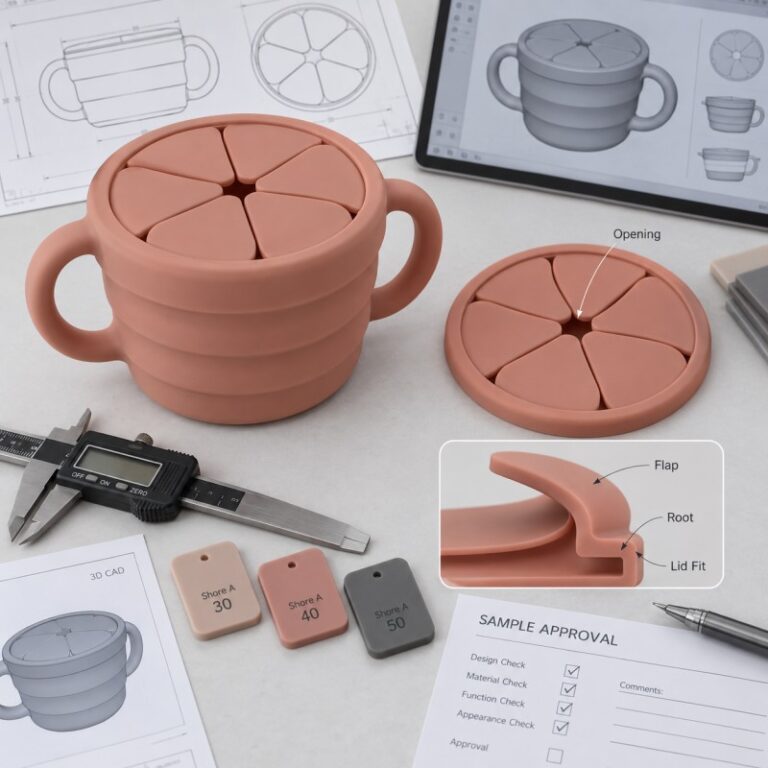
Good silicone snack cup flap design requires balancing easy hand access, flap recovery, spill control and long-term durability. If the flexible petals are too thick or too short, the opening may feel stiff. If they are too thin, too long or supported by a weak root area, they may remain open, curl or allow snacks to escape too easily.
For OEM baby feeding products, the flap lid should therefore be evaluated together with silicone hardness, opening diameter, flap geometry, root radius, lid fit and repeated-use behavior before mass production.
Why Is the Flexible Flap Lid the Most Important Part of a Silicone Snack Cup?
A silicone snack cup usually looks simple.
The cup holds snacks.
The flexible lid allows a child to reach inside.
But the lid has to perform two opposite functions:
- Open easily when a hand enters
- Return toward its original position after the hand is removed
If the flaps are too resistant, using the product becomes uncomfortable.
If they are too soft, the lid may remain open or provide very little spill control.
The engineering challenge is therefore not to make the flap as soft as possible.
It is to create controlled flexibility.
What Happens When the Flaps Are Too Stiff?
Stiff flaps can create several user-experience problems.
A child may need to apply excessive force to reach inside the cup.
The flap edges may press against the hand.
The lid may move together with the hand instead of flexing locally.
In some cases, the whole cup can lift or tilt when the user tries to access the snacks.
Possible causes include:
- Excessive flap thickness
- Short flap length
- Small central opening
- High silicone hardness
- Thick root area
- Insufficient relief between adjacent flaps
The correct solution depends on the complete geometry.
Simply making the silicone softer may not solve a poorly designed flap.
What Happens When the Flaps Are Too Soft?
The opposite problem also occurs.
Very soft flaps may:
- Sag into the cup
- Stay partially open after use
- Curl outward
- Allow snacks to fall out more easily
- Lose a neat appearance
- Become inconsistent after repeated bending
A flap can feel pleasant during the first sample test but still lack enough structural recovery.
For that reason, sample approval should include repeated use rather than only one hand-access test.
How Does the Central Opening Diameter Affect Performance?
The opening in the middle of the petal lid determines how far the flaps need to bend.
If the opening is very small:
- The hand must push the flaps farther
- Local bending increases
- Access may feel tighter
If the opening is very large:
- Hand access becomes easier
- Flap movement decreases
- Spill control may be reduced
The opening should therefore be selected according to:
- Intended age group
- Typical snack size
- Hand-access requirement
- Number of flaps
- Flap length
- Desired spill-control behavior
The final opening should be tested on the molded product rather than approved only from CAD.
How Many Flexible Flaps Should a Snack Cup Lid Have?
There is no universal number that works for every product.
A lid may use:
- Four flaps
- Five flaps
- Six flaps
- Another custom arrangement
Changing the number of flaps also changes:
- Flap width
- Root spacing
- Central opening geometry
- Bending behavior
- Appearance
Fewer wide petals may feel different from several narrow petals even when the lid diameter is identical.
The number of flaps should support the intended user experience, not simply follow an existing market product.
Why Is Flap Length Important?
Flap length controls how much flexible material can bend.
A longer flap generally has more opportunity to deform.
A shorter flap usually behaves more firmly.
However, very long flaps can:
- Sag more easily
- Overlap with adjacent flaps
- Recover slowly
- Become unstable near the center
Very short flaps can:
- Require greater force
- Create a narrow access zone
- Feel rigid
The best length depends on the relationship between the lid diameter, central opening and root position.
Why Does Flap Thickness Need Local Control?
A flap does not necessarily need the same thickness from root to tip.
The design can be reviewed as several zones:
- Root area
- Main bending area
- Tip area
The root needs enough support to resist repeated flexing.
The main flap needs enough flexibility to open comfortably.
The tip should remain smooth and soft enough for hand contact.
Abrupt thickness changes should be avoided because they may create local stress concentration.
This is where previous wall thickness principles become relevant, but the flap must still be evaluated as its own functional structure.
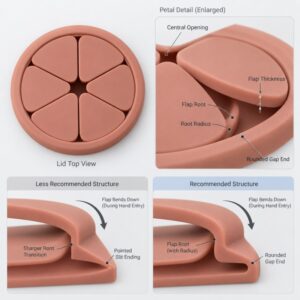
Why Is the Flap Root Radius Important?
The root is where the petal joins the outer lid ring.
This area experiences repeated bending every time a hand enters the snack cup.
If the root contains a very sharp internal corner, stress can concentrate in a narrow area.
Possible results include:
- Local whitening
- Small tears
- Permanent crease formation
- Uneven recovery
A smoother root transition distributes bending over a larger area.
The design should therefore consider:
- Root radius
- Flap thickness
- Adjacent gap
- Material hardness
- Repeated bending direction
The root should be strong enough to support the flap without making the entire lid excessively stiff.
How Does Silicone Hardness Change Flap Behavior?
The same flap geometry can feel completely different when molded in different hardness levels.
A softer silicone may provide:
- Easier hand entry
- Lower bending force
- Softer contact
But it may also create:
- More sagging
- Slower recovery
- Less spill resistance
A firmer silicone may improve:
- Shape definition
- Flap return
- Lid stability
but may increase hand-entry resistance.
This is why silicone hardness should be evaluated together with flap thickness and opening geometry.
It should not be selected independently.
Does the Lid Need the Same Hardness as the Cup Body?
Not always.
A snack cup may contain:
- A flexible flap lid
- A collapsible or standard cup body
- Integrated handles
These features do not necessarily have identical mechanical requirements.
However, using different materials or hardness specifications also affects:
- Production planning
- Color matching
- Inventory
- Quality control
Brands should only introduce different hardness specifications when they provide a clear functional benefit.
A simpler material system is usually easier to control during repeat production.
How Should the Lid Fit the Cup Rim?
The flexible petal lid still needs to remain securely attached to the cup.
The lid-to-cup interface should be reviewed for:
- Outer diameter
- Rim geometry
- Engagement depth
- Assembly force
- Removal force
- Repeated fit
If the lid is too loose, it may detach when a hand is pulled out.
If it is too tight, caregivers may find cleaning and reassembly inconvenient.
Fit should be validated on multiple molded samples.
This is an example where assembly fit matters even though the product appears visually simple.
How Should Adjacent Flaps Be Separated?
The gaps between petals allow each flap to move more independently.
However, the gap design should avoid creating problematic sharp ends.
The designer should review:
- Gap width
- Gap length
- Root termination
- Tip geometry
- Edge radius
A narrow slit that terminates in a sharp point may behave differently under repeated flexing than a carefully rounded relief.
The geometry should support repeated deformation without creating unnecessary tear initiation points.
Can Decorative Shapes Be Used for the Petal Lid?
Yes, but decoration should not interfere with function.
Brands may want:
- Flower-like petals
- Rounded triangular petals
- Soft geometric openings
- Character-inspired shapes
The important point is that every decorative change also changes the mechanical behavior of the flap.
For example, a narrow decorative tip may bend differently from a wide rounded tip.
A deep decorative cut may create a new stress concentration.
OEM teams should therefore evaluate the decorative shape as part of the functional lid structure.
How Does Repeated Use Affect Flap Recovery?
One successful opening test does not prove long-term behavior.
The flap will normally be bent many times during actual use.
Repeated flexing can reveal:
- Permanent curl
- Uneven petals
- Reduced return
- Root deformation
- Surface whitening
- Small tears
The test method should reflect expected use.
There is no need to invent an arbitrary universal cycle number.
Instead, the brand and manufacturer should define a realistic repeated-use test according to the product positioning and quality requirement.
Why Should Flap Recovery Be Checked After Packaging?
Flexible lids can also be affected by packaging.
If another product or accessory presses against the petals for a long time, the flaps may arrive temporarily distorted.
During packaging review, check whether:
- The central opening is compressed
- Petals are folded unnaturally
- The lid is stacked under excessive pressure
- Accessories press directly on the flap area
After unpacking, the lid should recover to the agreed shape within the product’s acceptance standard.
How Should Snack Size Affect Lid Design?
A snack cup designed for small dry snacks may need different flap behavior from one intended for larger pieces.
Important variables include:
- Snack dimensions
- Snack shape
- Number of pieces inside
- Cup orientation
- Intended spill-control level
Very large gaps may allow small snacks to escape.
Very restrictive flaps may make larger snacks difficult to remove.
For this reason, functional validation should use representative snacks or equivalent test objects rather than only testing with an empty cup.
What Should Brands Test During Sample Approval?
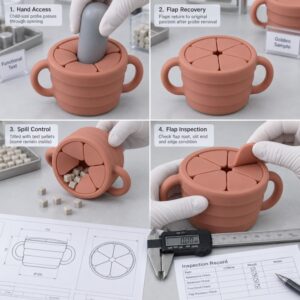
Hand Access
Check whether the intended user can insert and remove the hand comfortably.
Flap Recovery
After the hand is removed, observe whether all petals return toward their intended position.
Spill-Control Test
Add representative test contents and evaluate the cup in agreed tilt or movement conditions.
The goal should be based on a defined product requirement rather than an absolute promise that nothing can ever escape.
Lid Retention
Confirm that the lid remains attached while the hand enters and exits.
Edge Comfort
Check whether the flap tips and gaps feel smooth during repeated contact.
Repeated Flex
Bend the petals repeatedly and inspect:
- Root condition
- Shape recovery
- Surface appearance
- Tear initiation
Cleaning
Wash the lid and inspect the gaps, roots and underside.
Food-contact areas should be accessible according to the intended cleaning method.
Practical Example: Custom Collapsible Silicone Snack Cup
Consider a custom silicone snack cup with:
- Collapsible silicone body
- Two integrated side handles
- Removable flexible lid
- Six rounded petal flaps
- Central hand-access opening
The brand wants easy child access while reducing accidental snack spills during normal use.
Version A — Flaps Too Thick
The petals return quickly but require excessive hand-entry force.
Version B — Flaps Too Thin
Access feels soft, but several petals remain open after repeated use.
Optimized Version
The final design balances:
- Root support
- Main flap flexibility
- Rounded tips
- Controlled central opening
- Suitable silicone hardness
- Secure lid fit
The objective is not to maximize softness or stiffness.
The objective is repeatable, controlled movement.
Silicone Snack Cup Flap Design Checklist
| Item | What the Brand Should Confirm |
|---|---|
| Number of flaps | Suitable for opening size and product design |
| Central opening | Comfortable access with reasonable spill control |
| Flap length | Enough flexibility without excessive sagging |
| Flap thickness | Balanced bending and recovery |
| Root radius | Smooth repeated-flex transition |
| Tip geometry | Rounded and comfortable |
| Hardness | Validated together with geometry |
| Adjacent gaps | Move independently without sharp terminations |
| Lid fit | Secure but practical to remove |
| Hand access | Tested with intended user requirement |
| Recovery | Returns toward approved position after use |
| Repeated flex | No unacceptable tearing or permanent deformation |
| Snack test | Evaluated with representative contents |
| Cleaning | Gaps and underside remain accessible |
| Packaging | Petals are not stored under harmful compression |
How LYA Silicone Supports Custom Snack Cup Development
LYA Silicone’s current product range includes custom collapsible silicone snack cups with flexible petal-flap lids, collapsible bodies, integrated handles and OEM/ODM customization options.
For OEM/ODM silicone manufacturing, project development can include:
- Cup-size review
- Lid diameter
- Flap quantity
- Central opening
- Flap length
- Flap thickness
- Root-radius review
- Silicone hardness
- Lid-to-cup fit
- Collapsible body design
- Handle structure
- Pantone color
- Molded logo
- Tooling
- Sampling
- Functional testing
- Packaging
- Mass-production inspection
The most important step is to test the complete snack cup as a functional system rather than evaluating the flexible lid separately.
Frequently Asked Questions
Why do silicone snack cup flaps stay open?
Possible causes include excessive flap length, insufficient thickness, very soft silicone, weak root support or permanent deformation after repeated use or packaging.
Why is a silicone snack cup difficult for a child to reach into?
The central opening may be too small, the flaps may be too thick or short, or the selected silicone may be too firm for the geometry.
How many petals should a silicone snack cup lid have?
There is no universal number. Flap quantity should be designed together with lid diameter, central opening, flap width and intended hand-access behavior.
Should the snack cup lid be softer than the cup body?
It can be, but different hardness specifications increase production complexity. The final choice should be based on functional testing.
Can flexible flaps prevent every snack from spilling?
No design should be assumed to eliminate every possible spill condition. The brand should define the intended spill-control requirement and validate samples under agreed test conditions.
Why do silicone flaps tear near the root?
Sharp root geometry, excessive local bending, insufficient supporting thickness or repeated stress can increase tear risk.
Should flap recovery be tested before mass production?
Yes. Repeated bending, lid fit, recovery, cleaning and representative snack testing should be checked on molded samples before final approval.
Design the Lid Around Controlled Flexibility
A good silicone snack cup lid must balance:
Opening Size → Flap Quantity → Length → Thickness → Root Radius → Hardness → Recovery → Lid Fit → Spill Control
These variables work together.
Making one feature softer or thinner without checking the rest of the lid can create a new problem elsewhere.
If you are developing a flexible-lid feeding product, contact us with your reference design, target cup size, flap concept, intended user, snack type, color requirements, packaging concept and estimated order quantity.