 Russian
  English
  French
  German
  Spanish
  Polish
  Chinese
  Japanese
  Korean
 Содержание
Answer Excerpt
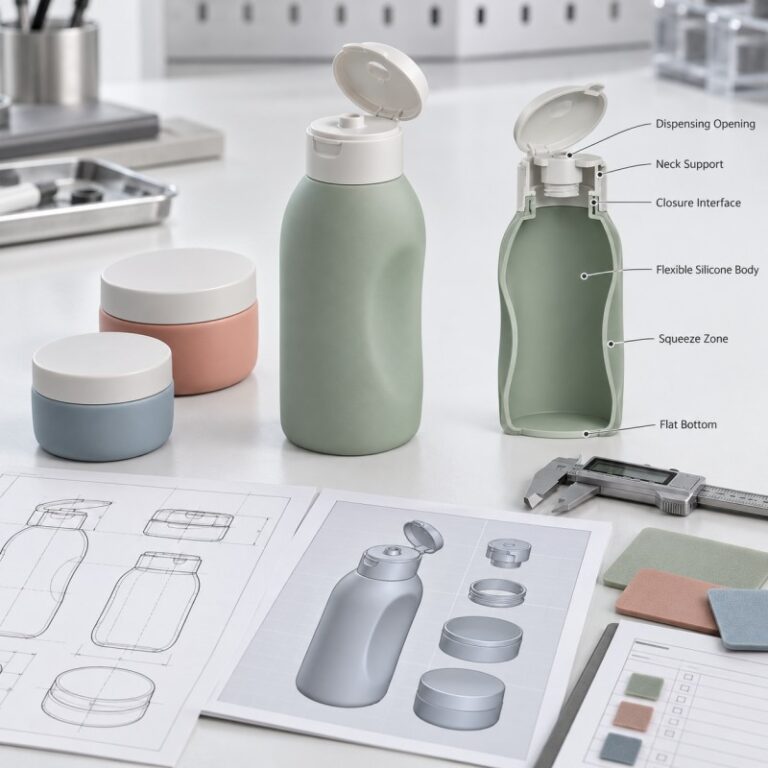
A well-designed silicone travel toiletry container should reduce leakage risk while remaining easy to squeeze, dispense, refill and clean. The most important variables are the closure interface, dispensing opening, bottle flexibility, silicone hardness, wall thickness, fill condition and shape recovery.
For OEM travel and personal-care brands, sealing performance should be validated on molded samples with representative liquids or test media rather than judged only from the appearance of the cap and bottle.
Why Are Travel Toiletry Containers More Difficult Than They Look?
A small travel bottle appears simple: a flexible body, an opening and a cap.
In real use, however, it may be stored upright, laid on its side, compressed inside luggage, repeatedly squeezed and opened, and filled with products that have different viscosities.
A travel container therefore needs to balance:
- Controlled dispensing
- Convenient squeezing
- Secure closure
- Shape recovery
- Refillability
- Cleaning access
- Compact packing
A very soft bottle may squeeze easily but deform too much around the neck.
A very small opening may reduce accidental flow but make thick lotion difficult to dispense.
The product should therefore be developed as one complete container system rather than as a silicone body with a cap added later.
Start With the Product That Will Be Stored Inside
Before deciding the opening size or bottle softness, define what the container is expected to hold.
Typical applications include:
- Shampoo
- Conditioner
- Lotion
- Facial cleanser
- Shower gel
- Cream and other thicker personal-care products
These products do not flow in the same way.
A structure that works well for a thin liquid may dispense poorly when filled with a thicker formulation.
During OEM development, define the product category, approximate flow behavior and intended dispensing method.
When possible, sample testing should use the actual formulation or a representative test medium with similar viscosity.
This prevents an empty container from being approved before its real-use behavior is known.
How Should the Dispensing Opening Be Designed?
The dispensing opening controls how easily material leaves the bottle.
If the opening is too small, users may need excessive squeeze force.
If it is too large, a lower-viscosity liquid may come out faster than intended.
The opening should be evaluated together with:
- Product viscosity
- Bottle size
- Expected squeeze force
- Cap design
- Desired dose control
There is no universal opening diameter that works for every travel bottle.
The objective is controlled dispensing, not simply the smallest possible hole.
Why Is the Closure Interface Critical for Leak Resistance?
Most leakage problems occur at an interface rather than through the silicone wall itself.
Depending on the product structure, the critical interface may be between:
- Cap and neck
- Lid and sealing land
- Plug and dispensing opening
- Collar and bottle body
The design team should review the actual sealing contact area, engagement depth, alignment and closing force.
A cap that feels tight is not automatically well sealed.
Excessive closing force can also make the product inconvenient to use.
For a custom silicone travel container, the closure should be evaluated in the fully assembled and filled condition.
How Does Silicone Hardness Affect Squeeze Control?
The same bottle geometry can behave very differently when the silicone hardness changes.
Softer silicone may provide:
- Easier squeezing
- Comfortable hand feel
- Lower dispensing force
However, excessive softness can allow the body or neck to collapse too much.
Firmer silicone may improve shape support but require greater hand force.
The correct material should therefore be selected together with:
- Bottle geometry
- Product size
- Stored formulation
- Intended squeeze behavior
Hardness should not be approved in isolation from the molded product.
Why Does Wall Thickness Need More Than One Design Zone?
A squeeze bottle does not necessarily need the same wall thickness everywhere.
The main body may need flexibility for dispensing, while the neck and bottom may need more structural support.
Useful design zones include:
- Main squeeze wall
- Shoulder transition
- Neck area
- Bottom support area
- Logo area
If the main wall is too thick, dispensing becomes difficult.
If the neck transition is too thin, the bottle may deform while the closure is being opened or closed.
Smooth thickness transitions usually allow deformation to spread more gradually through the bottle.
Why Is Shape Recovery Important After Squeezing?
After the user releases pressure, the bottle should recover toward its intended geometry.
Poor recovery can cause:
- Dented sidewalls
- A partially collapsed bottle
- Inconsistent dispensing on the next squeeze
- Reduced shelf appearance
Recovery depends on the combination of material, geometry and wall distribution.
Testing should include repeated squeezing rather than only one demonstration.
The design should also confirm how the container behaves after product has been dispensed and air needs to re-enter through the intended closure system.
How Should Brands Test Leakage Risk?
An empty upright sample is not enough.
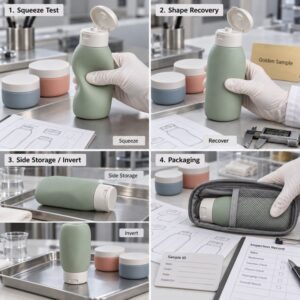
Depending on the project, the filled container may need to be evaluated:
- Upright
- On its side
- Inverted for an agreed period
- After repeated squeezing
- After repeated opening and closing
- After packing with other travel products
Fill condition is also important because an empty, partially filled and nearly full flexible bottle may behave differently.
The brand and manufacturer should agree on test conditions and acceptance criteria before sample approval.
Avoid describing a product as absolutely leakproof unless the finished product has been validated to the specific conditions and standards required for that claim.
For most OEM development projects, reducing leakage risk under defined conditions is a more useful engineering objective.
Why Can Packaging Create New Problems?
A container may perform well during a bench test but behave differently after packaging.
During storage and transport, neighboring products, retail inserts or tight travel pouches can place pressure on the soft bottle or closure.
This is why packaging deformation should be considered during product development.
Packaging should avoid:
- Keeping the bottle severely compressed
- Pressing directly on the flip-top area
- Forcing the closure sideways
- Holding the product in an unnatural shape
The final or representative bottle, closure and retail pack should therefore be reviewed together.
How Should Branding Be Added Without Hurting Function?
Molded logos and surface textures can support brand identity, but they also change local surface geometry.
Large raised details in the main squeeze zone may affect hand feel.
Deep recessed graphics can become more difficult to clean if personal-care residue reaches the area.
Logo placement should be coordinated with:
- Natural hand position
- Main squeeze zone
- Bottle curvature
- Parting line
- Packaging presentation
Branding should follow the functional bottle structure rather than being added after the design is already frozen.
How Should the Product Be Reviewed Before Tooling?
Before custom silicone mold development begins, the final design should clearly define:
- Overall bottle dimensions
- Target fill volume
- Main wall geometry
- Neck structure
- Dispensing opening
- Closure interface
- Bottom geometry
- Logo position
- Surface finish
- Intended material and hardness
- Critical inspection dimensions
The tooling team should also review mold filling, venting, parting-line position and demolding.
The closure area deserves particular attention because flash, mismatch or dimensional variation near a sealing surface can affect functional performance.
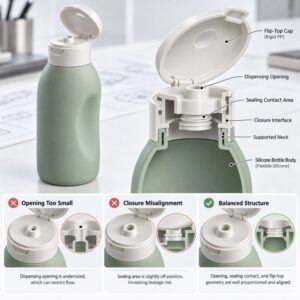
Practical Example: A Soft Silicone Travel Shampoo Bottle
Consider a compact flexible travel bottle intended for shampoo and body wash.
The bottle uses a soft silicone squeeze body and a matching closure assembly.
Version A — Body Too Soft
The bottle is easy to squeeze, but the neck twists during cap operation and the body remains dented after repeated use.
Version B — Dispensing Opening Too Small
The closure looks secure, but the user needs excessive force to dispense thicker shampoo.
Version C — Closure Fit Too Loose
The bottle is convenient to open, but side-storage testing shows inconsistent sealing performance.
Optimized Version
The final design balances:
- Bottle-wall flexibility
- Neck support
- Dispensing opening
- Closure engagement
- Fill condition
- Shape recovery
- Packaging protection
The correct solution is not simply a softer bottle or tighter cap.
It is a coordinated container system.
What Should Brands Check During Sample Approval?
Squeeze and Dispensing
Fill the bottle with representative product and confirm that squeeze force and product flow are appropriate.
Closure Fit
Open and close the product repeatedly.
Check alignment, engagement and ease of use.
Leakage Evaluation
Test the agreed orientations and storage conditions using the intended fill condition.
Shape Recovery
Inspect the bottle after repeated squeezing for persistent dents or unacceptable distortion.
Refill and Cleaning
Confirm that the opening supports the intended refill and cleaning method.
Packaging Review
Place the filled sample into the intended retail or travel packaging and check whether the closure or bottle receives unwanted pressure.
Multi-Sample Comparison
Compare several molded samples instead of approving only one ideal piece.
Silicone Travel Toiletry Container Design Checklist
| Артикул | What the Brand Should Confirm |
|---|---|
| Stored product | Shampoo, lotion, cleanser, gel or cream |
| Target fill | Defined according to intended use |
| Container size | Suitable for travel and product positioning |
| Silicone hardness | Balanced squeeze feel and structural support |
| Wall thickness | Flexible body with supported neck and bottom |
| Dispensing opening | Matched to product flow behavior |
| Closure interface | Stable fit and defined sealing contact |
| Shape recovery | Returns toward approved geometry |
| Refill access | Practical for intended use |
| Logo position | Does not interfere with squeezing |
| Mold design | Critical functional areas reviewed before tooling |
| Leakage evaluation | Checked under agreed conditions |
| Упаковка | Avoids harmful pressure on cap or body |
How LYA Silicone Supports Travel Container Development
LYA Silicone supports OEM and ODM development for custom silicone travel containers, including flexible travel bottles, cosmetic jars and compact travel storage products.
Project development can include:
- Product concept review
- Size and volume planning
- Bottle and closure structure
- Silicone hardness selection
- Wall-thickness review
- Color planning
- Molded-logo development
- Mold development
- Sample production
- Fit and leakage evaluation
- Packaging coordination
- Mass-production inspection
The objective is to develop a travel container that is convenient to use and suitable for repeat production while validating leakage risk under the conditions defined for the project.
Frequently Asked Questions
Can One Silicone Travel Bottle Work for Both Shampoo and Thick Cream?
It depends on the dispensing opening, bottle flexibility and product viscosity.
The structure should be validated using the intended formulation or a representative test medium.
Does Softer Silicone Always Make a Better Squeeze Bottle?
Нет.
Very soft silicone may improve squeezing but reduce neck support and shape stability.
Is a Tighter Cap Always Less Likely to Leak?
Not necessarily.
Effective sealing depends on closure geometry and sealing contact, not simply how difficult the cap feels to open.
Should Travel Bottles Be Tested While Filled?
Yes.
Filled and empty flexible containers can behave differently during squeezing, storage and closure testing.
Can Packaging Affect a Travel Bottle After Production?
Yes.
Compression during storage or transport can deform a soft bottle or place unwanted pressure on the closure.
Design the Container as One Functional System
A reliable travel toiletry container depends on:
Stored Product → Bottle Wall → Neck → Dispensing Opening → Closure → Fill Level → Recovery → Packaging
These elements work together.
If you are developing a new travel bottle, cosmetic jar or private-label toiletry set, contact us with your product type, target capacity, stored formulation, closure concept, color, logo, packaging requirements and estimated quantity.