 Russian
  English
  French
  German
  Spanish
  Polish
  Chinese
  Japanese
  Korean
 Содержание
Answer Excerpt
Multi-cavity molds can improve production efficiency for индивидуальные силиконовые изделия, but every cavity must produce parts within the same approved dimensional, appearance and functional limits. Differences in filling, gate condition, venting, mold temperature, cavity surface, clamping and wear can create cavity-to-cavity variation. Buyers should therefore approve samples by cavity number and maintain cavity-specific inspection records during pilot production and mass production.
When a silicone product moves from sampling into larger-volume production, the manufacturer may use a mold containing several identical cavities.
Instead of producing one part during each molding cycle, the mold may produce:
- 2 parts
- 4 parts
- 8 parts
- 16 parts
- Or many more, depending on product size and production requirements
This can significantly improve output.
LSR technology is well suited to scalable multi-cavity production; industrial systems have been demonstrated with dozens or even hundreds of cavities when the mold, filling and process-control system are designed accordingly.
However, one important question appears:
Does every cavity actually produce the same product?
The goal is not mathematical identity.
The goal is for every cavity to remain inside the approved range for:
- Dimensions
- Product weight
- Hardness
- Цвет
- Surface finish
- Flash
- Gate appearance
- Texture
- Functional performance
What Is a Multi-Cavity Silicone Mold?
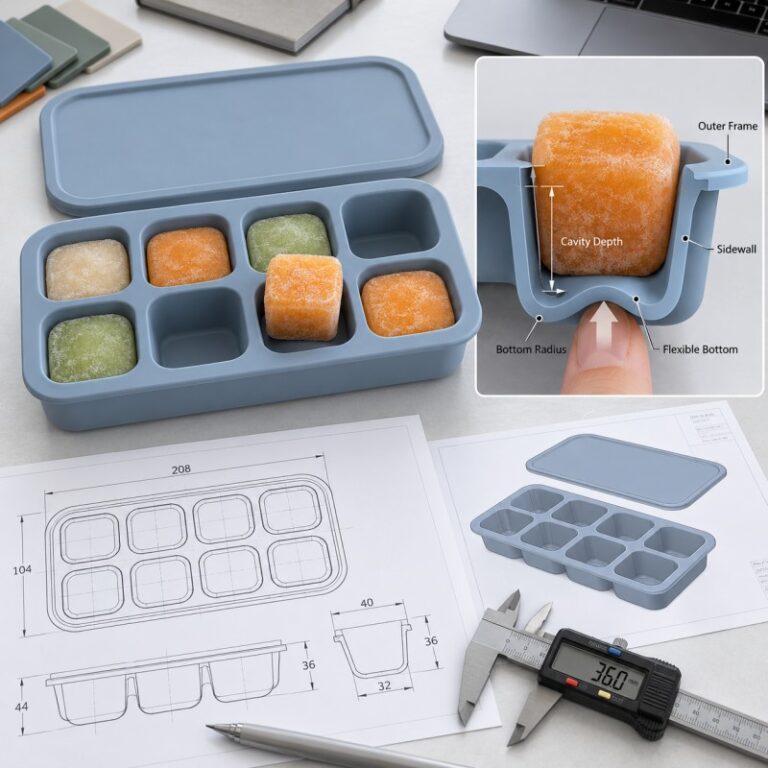
A multi-cavity mold contains several product cavities inside the same tool.
Each cavity forms one silicone part during a molding cycle.
For example, a four-cavity mold for a custom silicone baby teether may produce four identical teethers at the same time.
The product design may be identical, but the cavities still occupy different positions inside the mold.
Each cavity has its own:
- Flow path
- Gate
- Venting condition
- Local mold surface
- Temperature environment
- Demolding position
For this reason, the manufacturer should not assume that four cavities automatically produce four perfectly identical results.
Your current teether product line already supports custom shape, texture, Shore A hardness, mold development, sampling and bulk production, making cavity consistency directly relevant to this type of OEM project.
Why Can Different Mold Cavities Produce Different Results?
1. Material May Not Fill Every Cavity Equally
In a multi-cavity LSR mold, the runner and gate system needs to distribute material consistently.
If one cavity receives material differently from another, possible differences may appear in:
- Product weight
- Thin-feature filling
- Texture definition
- Gate appearance
- Surface marks
Advanced multi-cavity systems can use individually controlled needle shut-off technology to manage cavity filling. ENGEL has publicly described systems where individual cavities in very large LSR molds can be controlled separately.
For ordinary consumer silicone products, the exact mold system may be simpler, but the principle remains the same:
The filling system needs to remain balanced.
2. Venting Can Differ Between Cavities
As silicone fills each cavity, air must escape.
If cavity 1 vents effectively but cavity 4 has weaker venting, cavity 4 may show:
- Air marks
- Incomplete fine details
- Small bubbles
- Local flash
- Different surface appearance
Vent performance can also change during production because of residue or mold contamination.
This is why cavity-specific defect tracking is useful.
If the same defect repeatedly appears only on cavity 3, the engineering team has a much better starting point for investigation.
3. Mold Temperature Can Vary Across the Tool
LSR cures inside a heated mold.
The local thermal condition can influence how the material fills and cures.
For a larger mold, cavities located in different areas may not always experience exactly the same conditions.
Industrial LSR systems therefore place strong emphasis on controlled molding conditions and reproducible process control.
Buyers do not need to specify machine settings themselves.
But they should expect the manufacturer to verify that cavity-to-cavity differences remain within the approved product standard.
4. Clamping Condition Can Influence Flash
LSR can enter very small gaps.
If mold closing or clamping conditions are uneven, some cavities may show more flash than others.
ENGEL specifically notes that even clamping-force distribution and platen parallelism are important for maintaining consistent quality across large multi-cavity LSR molds.
For a small consumer product, the symptoms may appear as:
- More edge flash on one cavity
- Different parting-line appearance
- Local thickness differences
- Higher trimming requirements
The manufacturer should compare flash by cavity rather than treating all samples as one mixed batch.
Why Should Every Cavity Have an Identification Number?
Cavity identification makes defect tracing much easier.
For example:
- Cavity 1
- Cavity 2
- Cavity 3
- Cavity 4
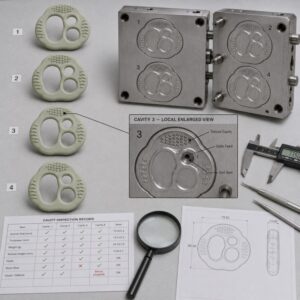
During mold trials and pilot production, each sample should remain traceable to its cavity.
This allows the team to answer questions such as:
- Does cavity 2 consistently weigh less?
- Does cavity 3 show more flash?
- Does cavity 4 have a weaker texture?
- Is one cavity producing a slightly different dimension?
- Does one cavity create a repeated appearance mark?
Without cavity identification, all parts are mixed together and the production team loses valuable diagnostic information.
What Should Be Compared Between Cavities?
Product Weight
Weight can help identify filling differences.
A small difference does not automatically mean the product is defective, but repeated cavity-specific weight variation can indicate inconsistent filling.
Critical Dimensions
Measure dimensions that affect:
- Fit
- Assembly
- Grip
- Hole size
- Product stability
- Функция
Not every flexible decorative edge requires the same inspection intensity.
Surface Appearance
Compare:
- Gloss
- Matte texture
- Flow marks
- Black spots
- Parting lines
- Gate marks
- Flash
Your current color-control article already notes that cavity temperature, venting, flow, surface condition and mold repair can create appearance differences between cavities.
Fine Texture
For a silicone teether, check:
- Raised dots
- Waves
- Ridges
- Small recessed details
- Molded logos
Every cavity should reproduce the approved texture clearly.
Functional Performance
Appearance alone is not enough.
Depending on the product, test:
- Flexibility
- Suction
- Folding
- Lid fit
- Pulling
- Shape recovery
- Assembly
Example: Four-Cavity Silicone Baby Teether Mold
Consider a four-cavity mold producing the same one-piece silicone teether.
The teether contains:
- A large grip ring
- Two smaller openings
- Raised chewing dots
- Wave textures
- A molded logo
- Thin connecting areas
During pilot production, the factory should not randomly select four products.
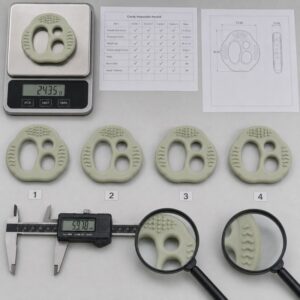
Instead, samples should be recorded as:
Cavity 1 Sample
Cavity 2 Sample
Cavity 3 Sample
Cavity 4 Sample
Then compare:
- Overall dimensions
- Hole dimensions
- Product weight
- Texture height
- Flash
- Surface appearance
- Цвет
- Product flexibility
If cavity 4 repeatedly produces incomplete texture, the mold team can focus on cavity 4’s gate, venting, local surface and related process conditions.
That is much more efficient than changing the entire production process without knowing where the defect originates.
Why Is Pilot Production Important?
A mold may produce several excellent samples during the first trial.
That does not automatically prove long-term cavity consistency.
Pilot production helps evaluate what happens over a longer run.
The team can observe:
- Whether one cavity begins to develop flash
- Whether venting changes
- Whether product weight remains stable
- Whether demolding differs between cavities
- Whether surface appearance remains consistent
- Whether mold cleaning affects particular cavities
LSR manufacturing is designed for repeatable, scalable production, but stable results still depend on material, mold and process control working together.
What Happens If One Cavity Is Out of Specification?
The first response should not be to adjust the entire mold blindly.
The team should identify:
- Which cavity is affected
- Which defect is repeated
- When the defect began
- Whether it appears every cycle or intermittently
Possible investigation areas include:
- Gate condition
- Runner balance
- Venting
- Mold temperature
- Cavity surface
- Flash
- Mold wear
- Demolding
- Machine parameters
The corrective action should target the actual cause.
Should All Cavities Be Approved Before Mass Production?
Yes.
A buyer should not approve a production mold based only on the best-looking sample.
Before full production, the manufacturer should confirm that active cavities meet the same agreed:
- Product drawing
- Appearance standard
- Critical dimensions
- Functional test
- Color standard
- Packaging requirements
For higher-risk dimensions or visual areas, cavity-specific records should be retained during qualification.
Multi-Cavity Mold Inspection Checklist
| Inspection Item | What Should Be Confirmed |
|---|---|
| Cavity identification | Every sample can be traced to its mold cavity |
| Filling | No cavity repeatedly shows short filling |
| Product weight | Cavity-to-cavity variation remains controlled |
| Dimensions | Critical dimensions meet the approved drawing |
| Venting | No repeated air-trap defect in one cavity |
| Flash | Parting-line and edge condition remain consistent |
| Surface | Gloss, texture and flow appearance are comparable |
| Цвет | No cavity repeatedly appears different |
| Fine details | Logos and textures reproduce correctly |
| Функция | Every cavity passes the required functional test |
| Pilot production | Consistency remains stable during longer runs |
| Maintenance | Cavity-specific changes are recorded |
How LYA Silicone Supports Multi-Cavity Mold Quality Control
LYA Silicone provides OEM and ODM development for silicone baby, pet, outdoor and educational products. Its current OEM workflow includes drawing or sample evaluation, mold development, sample confirmation and mass production quality control.
For multi-cavity projects, production review may include:
- Product drawing review
- custom silicone mold development
- Runner and cavity planning
- Sample identification by cavity
- Dimensional inspection
- Product-weight comparison
- Surface inspection
- Texture inspection
- Functional testing
- Pilot production
- Mass-production monitoring
The objective is not only to produce more parts per cycle.
The objective is to produce more consistent parts per cycle.
Frequently Asked Questions
Does More Mold Cavities Always Mean Lower Unit Cost?
Not automatically.
More cavities can increase output, but tooling complexity, product size, mold design, production quantity and inspection requirements also affect total cost.
Can One Cavity Produce a Different Color?
The material batch may be the same, but differences in local mold surface, temperature, flow or texture can make one cavity appear slightly different.
Should Every Cavity Be Measured?
Critical dimensions should be checked across all active cavities during mold qualification.
Why Does Only One Cavity Have More Flash?
Possible causes include local mold condition, clamping, cavity surface, venting or wear.
The affected cavity should be investigated individually.
Can a Multi-Cavity Mold Be Used for Different Product Colors?
Yes, but color production strategy depends on mold and production planning.
Within one normal molding shot, cavities generally receive the same prepared material feed unless the mold/process was specifically engineered otherwise.
Is Cavity Numbering Useful After Mass Production Starts?
Yes.
Cavity traceability can help identify repeated production defects and reduce unnecessary sorting or mold adjustment.
Approve the Mold by Cavity, Not by One Perfect Sample
A multi-cavity silicone mold should be evaluated as several repeated production positions working together.
Before mass production, buyers and manufacturers should confirm:
- Cavity identification
- Filling balance
- Dimensions
- Product weight
- Venting
- Flash
- Surface appearance
- Fine details
- Functional performance
To review a multi-cavity mold project for your custom silicone product, send LYA Silicone your 3D drawing, target dimensions, material requirement, hardness, estimated order quantity and critical quality requirements.