 Polish
  English
  French
  German
  Spanish
  Chinese
  Japanese
  Korean
  Russian
 Zawartość
Answer Excerpt
Is silicone safe for cats? Silicone can be suitable for certain cat toys, feeding accessories and grooming products when the material and finished-product design are appropriate for the intended use. However, silicone is not automatically safe for every cat or every application.
For silicone cat teething toys and other pet products, brands should review material formulation, product dimensions, chew resistance, detachable components, surface texture, cleaning requirements and applicable testing before mass production.
The most important distinction is between the suitability of the material and the safety of the complete finished product.
Is Silicone Generally Suitable for Cat Products?
Silicone rubber is used in many flexible consumer and pet products because it can provide:
-
Soft and flexible structures
-
Elastic recovery
-
Molded surface textures
-
A range of material hardness options
-
Reusable product designs
-
Smooth surfaces that can be cleaned
-
Customized shapes and colors
These characteristics make silicone an option for certain cat feeding accessories, enrichment products, grooming tools and interactive toys.
However, suitability depends on the actual product.
A silicone feeding mat has different requirements from a chew toy. A toy intended for supervised interaction may require different structural controls from a product used during feeding.
Pet brands should therefore evaluate silicone based on the product’s intended function rather than relying on the material name alone.
Does Food-Grade Silicone Mean a Product Is Safe for Cats?
Not necessarily.
The term “food-grade silicone” generally refers to material suitability for defined food-contact applications.
It does not automatically prove that a finished cat toy is safe for chewing, pulling or repeated biting.
A product may use a silicone formulation intended for food contact and still have structural problems, such as:
-
Małe odłączane części
-
Thin sections that can tear
-
Sharp edges created after damage
-
Weak accessory connections
-
Openings that create an entrapment risk
-
Inappropriate overall dimensions
Likewise, a material document does not automatically establish compliance for every pigment, additive, manufacturing process or finished-product configuration.
For OEM projects, brands should confirm the material specification and identify which tests are relevant to their intended product and target market.
Material selection is one part of product evaluation, not a substitute for finished-product assessment.
What Happens If a Cat Chews or Swallows Silicone?
Silicone does not become harmless simply because it is flexible or commonly used in household products.
If a cat damages a toy and swallows a fragment, the material may create a foreign-body hazard.
Potential concerns include choking or gastrointestinal obstruction, depending on the fragment and circumstances.
This is why brands should avoid statements such as:
-
Completely indestructible
-
Safe for unlimited chewing
-
Impossible to swallow
-
Safe for every cat
A product should be designed for a defined use scenario, and pet owners should be advised to inspect toys and discontinue use when damage appears.
If a cat is suspected of swallowing a silicone fragment, veterinary advice should be sought promptly rather than assuming the material will pass safely.
For manufacturers, the engineering objective is to reduce foreseeable breakage and detachment risks through suitable design and testing.
How Do Different Silicone Cat Products Create Different Risks?
Not every silicone cat product experiences the same type of load or user interaction.
Silicone Cat Chew Toys
A chewing toy may experience repeated:
-
Biting
-
Pulling
-
Twisting
-
Bending
-
Local compression
The main design priorities include structural continuity, suitable dimensions, smooth edges and resistance to tearing under the intended conditions.
Silicone Lick Mats
Silicone pet lick mats are intended to hold spreadable food or treats within molded surface patterns.
For these products, important considerations include:
-
Food-contact suitability
-
Groove depth
-
Cleaning access
-
Mat stability
-
Suction-cup design where applicable
-
Resistance to damage if the cat begins chewing the mat
A lick mat designed for licking should not automatically be treated as a dedicated chew toy.
Silicone Feeding Bowls
Feeding bowls need suitable wall stability, practical cleaning geometry and appropriate material selection for the intended feeding conditions.
Interactive Cat Toys
Interactive products may contain multiple components, such as a silicone body, a holder or a separate accessory.
These products require additional review of assembly interfaces and component retention.
The complete product should be evaluated according to its actual use rather than assigning one general safety claim to every silicone pet item.
How Does Silicone Hardness Affect Cat Toy Design?
Silicone hardness influences how a product responds to deformation.
Softer silicone may provide greater flexibility and a softer contact feel.
Firmer silicone may provide more structural support and different resistance to bending.
However, neither softer nor harder silicone automatically creates a safer cat product.
The final behavior also depends on:
-
Product dimensions
-
Wall thickness
-
Cross-section geometry
-
Material formulation
-
Local stress concentration
-
Surface texture
-
Expected chewing or pulling force
For example, a thick rounded silicone toy may behave differently from a thin flexible toy even when both use the same nominal hardness.
Brands should therefore evaluate actual molded samples rather than approving a product based only on a hardness value.
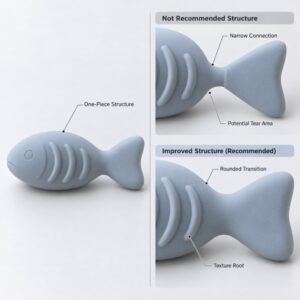
Why Are One-Piece Structures Worth Considering?
A one-piece silicone structure can reduce the number of separate assembly interfaces.
For certain simple cat toys, this may offer practical advantages:
-
Fewer detachable components
-
No separate mechanical fastener
-
Continuous material structure
-
Simpler cleaning geometry
-
Fewer component-retention points to inspect
However, one-piece construction does not eliminate all risks.
A one-piece product can still tear if its geometry contains weak sections or if it is used beyond its intended conditions.
The designer should review the whole structure, including:
-
Narrow connecting areas
-
Decorative projections
-
Internal openings
-
Flexible tails or tabs
-
Raised features
-
Transitions between thick and thin regions
The goal is a suitable functional structure, not simply the lowest possible number of components.
Why Should Small Parts and Accessories Receive Special Attention?
Some cat toys use additional accessories to create movement or interaction.
Examples can include feathers, bells, catnip holders, cords or separate attachment features.
Every additional component creates another design consideration.
The manufacturer and brand should determine:
-
Whether the accessory is intended to be removable
-
How it connects to the silicone body
-
Whether the connection can withstand expected use
-
Whether a detached part presents a hazard
-
How damage will be identified
-
What user instructions are necessary
These issues cannot be resolved by silicone material selection alone.
For a simple chewing-focused toy, brands may prefer a design without unnecessary detachable accessories.
For an interactive toy, the complete assembly needs an appropriate validation plan.
How Should Surface Texture and Geometry Be Evaluated?
Surface texture affects more than appearance.
Raised dots, ribs and grooves can change how a cat interacts with the product.
However, excessively tall or narrow features may create local stress concentrations.
The silicone product surface finish should be reviewed together with the intended function.
Important considerations include:
Rounded Edges
Avoid unnecessary sharp or needle-like projections.
Texture Height
Raised details should have enough structural support at their roots.
Cleaning Access
Very deep or tightly spaced grooves can retain food or residue.
Visual Inspection
The surface should make unusual damage or tearing reasonably easy to identify.
Moldability
The selected texture should be suitable for repeatable molding and demolding.
A complicated texture does not automatically provide better functionality.
For OEM buyers, surface details should support a specific purpose rather than being added only to differentiate the product visually.
Why Does Product Size Matter for Cat Toys?
Cats vary in size, age, behavior and play preferences.
A toy that is appropriate for one use scenario may be unsuitable for another.
The brand should determine:
-
Target cat size
-
Intended interaction
-
Whether chewing is expected
-
Whether the toy is handheld, floor-based or attached
-
Whether use requires supervision
-
Expected storage and cleaning conditions
A small toy should not be assumed safe simply because it is easy for a cat to carry.
Similarly, a large toy may need additional review of weight, flexibility and handling.
The product’s overall dimensions should be selected based on the intended use and relevant safety assessment.
Why Is Cleaning Important for Silicone Cat Products?
Silicone surfaces can collect saliva, food residue, hair, dust and other contamination during use.
Although simple silicone geometries can be relatively easy to wash, complex product shapes may still contain difficult-to-clean areas.
Designers should pay attention to:
-
Deep grooves
-
Blind holes
-
Narrow gaps
-
Removable components
-
Hollow regions
-
Accessory connections
Cleaning instructions should match the actual material and finished-product design.
A manufacturer should not automatically claim that every silicone cat toy can be boiled, sterilized or placed in a dishwasher without appropriate validation.
The intended cleaning method should be included in the product specification.
What Should Pet Brands Confirm Before Mold Development?
Material suitability and functional requirements should be discussed before custom silicone mold development begins.
The buyer and manufacturer should review:
-
Intended product function
-
Target cat or user group
-
Product dimensions
-
Material formulation
-
Silicone hardness
-
Wall structure
-
Surface texture
-
Potential tear-prone regions
-
Assembly interfaces
-
Cleaning requirements
-
Target sales market
-
Testing and documentation requirements
The tooling team should also evaluate mold filling, parting-line location, demolding and the consistency of critical features.
Some design changes become more expensive after tooling is completed.
Early review therefore helps brands identify unnecessary risks before production investment increases.
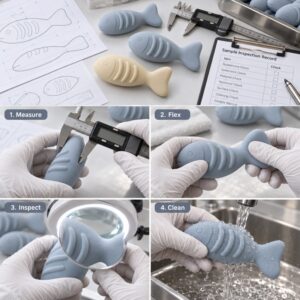
How Should Silicone Cat Toy Samples Be Tested?
Sample testing should reflect the actual product.
Dimensional Inspection
Confirm that the molded product matches the approved drawing.
Visual and Edge Inspection
Check for flash, unexpected sharp edges, incomplete features, surface contamination and visible defects.
Flexibility Evaluation
Apply controlled bending according to the intended product function.
Check whether the product recovers without unacceptable permanent deformation.
Pull and Tear Evaluation
Evaluate relevant high-stress features using agreed methods and acceptance criteria.
Component Retention
For multi-component products, check whether accessories remain appropriately secured under the intended testing conditions.
Cleaning Evaluation
Wash and dry the sample using the intended method.
Confirm that residue can be removed from important areas.
Packaging Review
Verify that the final packaging does not unnecessarily deform the product or obscure relevant instructions.
Multi-Sample Comparison
Evaluate multiple molded samples to check whether critical dimensions and functional behavior are consistent.
The testing plan should be defined for the product, not copied indiscriminately from another category.
Practical Example: One-Piece Silicone Cat Chew Toy
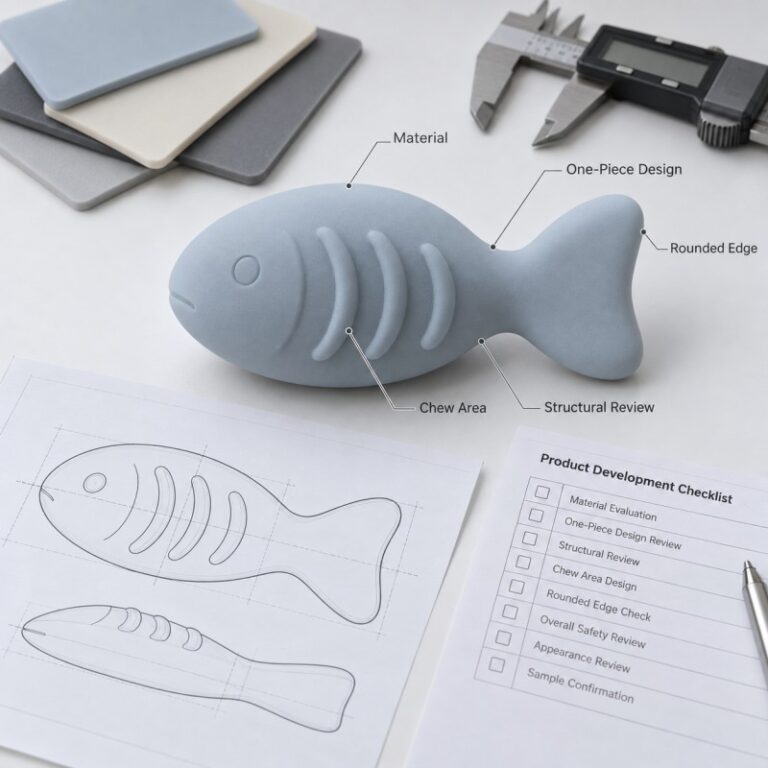
Consider an OEM pet brand developing a small, rounded fish-shaped silicone cat toy.
The product concept uses:
-
One-piece silicone construction
-
Rounded outer edges
-
Shallow molded texture
-
No separate bells or detachable decorations
-
A simple, easy-to-rinse surface
Version A — Thin Decorative Features
The design contains very thin fin-like projections.
These features may be more vulnerable to repeated biting or pulling.
Version B — Complex Accessory Connections
The product includes several attached decorative parts.
This creates additional component-retention and inspection requirements.
Improved Design
The revised concept uses a compact continuous body, broadly rounded transitions and fewer unnecessary projections.
The design may be simpler to inspect and clean, but it must still undergo product-specific evaluation.
A revised shape should never be described as fully chew-proof or completely safe without supporting evidence.
Silicone Cat Product OEM Checklist
| Evaluation Item | What the Brand Should Confirm |
|---|---|
| Product function | Chew toy, lick mat, feeding bowl or interactive toy |
| Target user | Cat size and intended use |
| Materiał | Appropriate silicone formulation |
| Color and additives | Evaluated for intended requirements |
| Overall dimensions | Suitable for the product concept |
| Wall structure | Avoids unnecessary weak sections |
| Surface texture | Rounded and practical to clean |
| Small parts | Potential detachment hazards reviewed |
| Assembly | Connection and retention requirements defined |
| Mold quality | Critical features form consistently |
| Czyszczenie | Method validated for final product |
| Functional tests | Appropriate to actual use |
| Opakowanie | Includes relevant product information |
| Inspection | Approved sample and criteria established |
| Target market | Applicable requirements identified |
How LYA Silicone Supports Custom Cat Product Development
LYA Silicone supports OEM and ODM development for customized silicone pet products, including cat toys, feeding accessories and other pet-care products.
Depending on the project, development support can include:
-
Product concept and drawing review
-
Material specification discussion
-
Silicone hardness selection
-
Structural design evaluation
-
Rozwój pleśni
-
Color and logo customization
-
Sample production
-
Dimensional and appearance inspection
-
Functional evaluation
-
Packaging coordination
-
Mass-production quality control
For cat toy projects, the final material, structure and testing requirements should be approved based on the product’s intended use and target market.
Frequently Asked Questions
Is Silicone Toxic to Cats?
There is no useful universal yes-or-no answer for every silicone product. Suitability depends on the specific formulation, additives, exposure route and finished design. A material being described as silicone does not establish that every product is suitable for a cat.
Can Cats Safely Chew Silicone Toys?
Some silicone products are designed for chewing, but suitability depends on the complete toy and the cat’s behavior. Damage, detachment and swallowing hazards must be considered. Supervision and regular inspection remain important.
What If a Cat Swallows a Piece of Silicone?
A swallowed fragment may create a foreign-body hazard. Contact a veterinarian promptly if ingestion is suspected.
Is Food-Grade Silicone Better for Cat Toys?
Food-contact suitability can be relevant to material selection, but it does not replace evaluation of chewing behavior, mechanical integrity or finished-product safety.
Are One-Piece Silicone Cat Toys Safer?
One-piece designs can reduce detachable assembly interfaces, but they may still tear or become unsuitable through damage. The complete product must be assessed.
Can Silicone Cat Toys Be Made in Custom Shapes?
Yes. Custom shape, texture, color and branding can be evaluated through OEM manufacturing, subject to product requirements and tooling feasibility.
Should Brands Test the Final Product Before Mass Production?
Yes. Material documents alone are not a substitute for reviewing the molded product’s dimensions, structural integrity, surface quality, cleaning requirements and intended use.
Design the Complete Cat Product, Not Just the Material
A suitable silicone cat product requires coordinated decisions about:
Material → Structure → Dimensions → Texture → Components → Testing → Cleaning → Packaging
Silicone can offer useful flexibility and customization for pet product development, but it does not remove the need for sound engineering or appropriate product validation.
If you are developing a custom silicone cat toy, lick mat or other pet product, contact us with your product concept, drawing, intended use, target market, material requirements, packaging plan and estimated order quantity.